
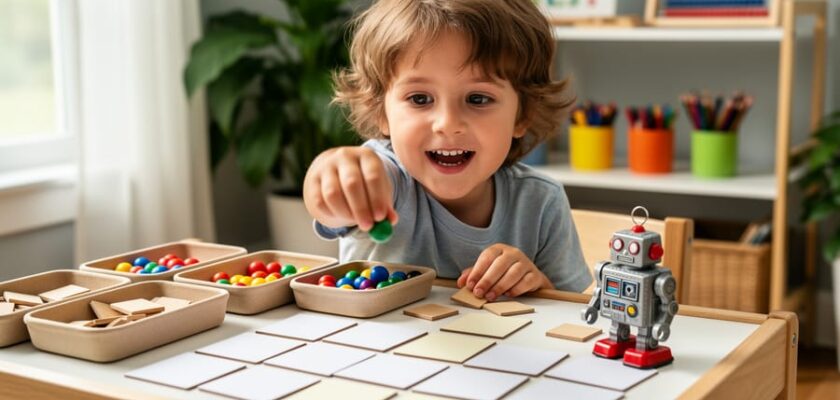
The best homeschooling ideas for 4 year olds are short, hands-on games that feel like play: counting treasure hunts, rhyme matching, sorting bins, and screen-free coding challenges. Most take five to fifteen minutes, need things you already own, and cover early math, pre-reading, logic, and fine motor skills all at once.
If you’re wondering how formal this should look, here’s the good news: it shouldn’t. At four, children learn best by touching, moving, and giggling their way through ideas. Think of it as gameschooling for kindergarten just one step earlier and a little sillier.
Below, you’ll find 8 low-prep activities, from Letter Sound Hopscotch to Robot Commander, chosen because they use everyday supplies, build real STEM foundations, and work in short bursts. Each one comes with a “try it now” prompt, so you can start before your coffee gets cold.
Ready to play?
How We Picked These Gameschooling Ideas for Little Learners
Before we dive into the games, here’s how we chose them. This is a curated list built around what works well for little learners, not a hands-on test of every activity. We looked for ideas that fit a four-year-old’s world, and we kept the whole thing playful, since gameschooling for the very young means play comes first and the learning sneaks in. If you’re hoping for math that clicks without tears, starting with games is a great move.
Every idea had to pass these checks:
- Age-appropriate: the rules are simple enough for a four-year-old to follow and feel proud of.
- Short and sweet: each game fits into 5 to 15 minutes, right about one wiggly attention span.
- Low prep, low cost: you can set up with paper, crayons, and things already in your kitchen or toy bin.
- A mix of skills: you’ll find early math, pre-reading, pre-coding logic, and fine motor practice.
- Flexible for your day: games work for one child or siblings, and you can stretch or shrink them on busy or calm homeschool days.
Pick one that makes you smile and give it a try.
1. Counting Treasure Hunt: Math Adventures Around the House
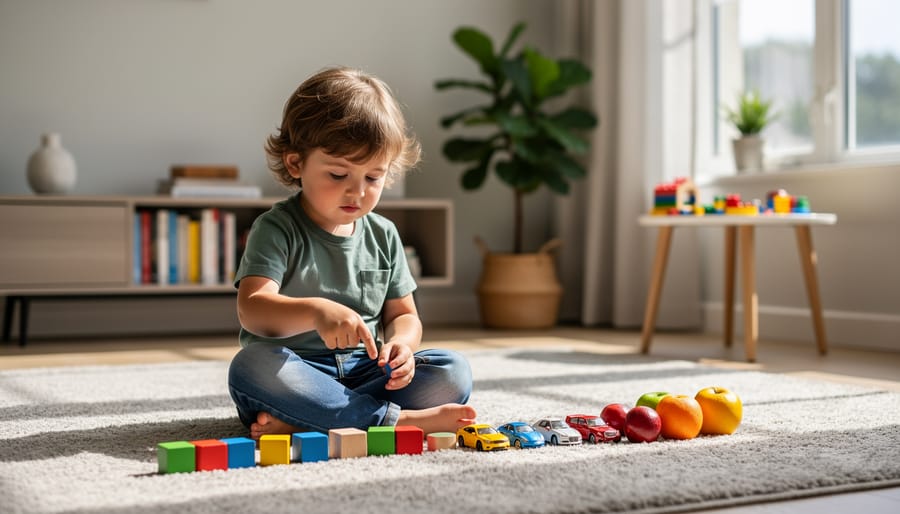
Ahoy, matey! Turn counting into a treasure hunt, and your 4 year old will practice math without noticing.
Make a simple picture card list: draw 3 socks, 5 blocks, and 7 buttons, or whatever you have handy. Your child reads the picture, hunts for that many objects, and brings the loot back to a “treasure chest” (a bowl or a box works great). Counting each item out loud as it goes into the chest builds one-to-one correspondence, which just means touching each object once while saying one number.
Setup tip: Keep the hunt to one room and stash the objects in easy spots, so your child feels like a winner right away.
Adjust the challenge to fit your little pirate:
– Beginner: Hunt for 1 to 3 objects, with dots drawn on each card to match.
– Growing: Hunt for up to 6 objects, with number symbols on the cards.
– Challenge: Hunt for up to 10, and ask “Which pile has more?”
Add a pirate hat, a paper eye patch, and a “treasure map” drawn on scrap paper. Suddenly, counting socks feels like a swashbuckling quest.
2. Rhyme Time Memory Match: Sounds, Words, and Giggles
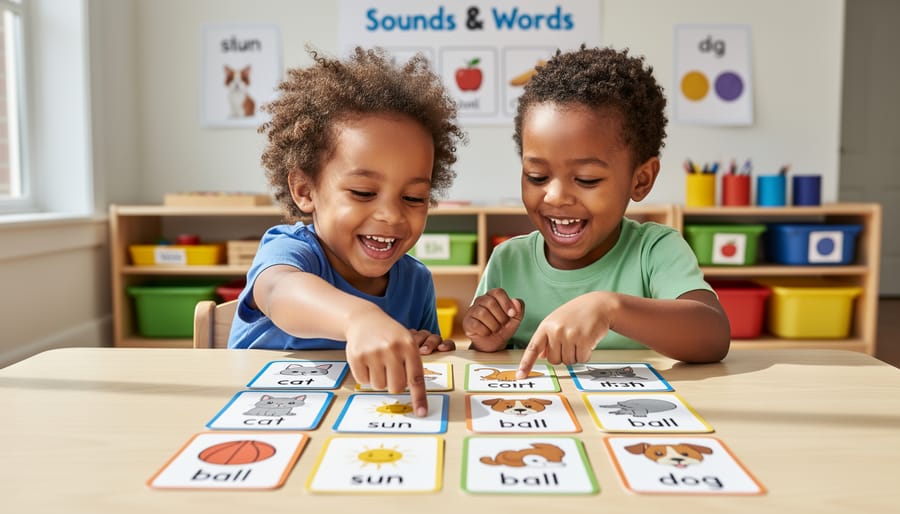
Want a game that tickles little ears? Try Rhyme Time Memory Match. A rhyme is when two words end with the same sound, like cat and hat. Hearing those matching sounds helps your child tune into the building blocks of reading, and the memory part gives their focus a workout too.
What you’ll need: paper, scissors, and crayons.
1. Cut 12 small cards from your paper.
2. Draw six pairs of rhyming pictures, one on each card. Good starters are cat/hat, bee/tree, sun/bun, dog/log, star/car, and mouse/house.
3. Mix the cards up and lay them face down in rows.
4. Take turns flipping two cards. If the pictures rhyme, keep the pair!
Say each word out loud together as you flip. If your child gets stuck, stretch the sounds like you’re singing: “caaat… haaat!”
Stick figures are perfectly fine. Your 4 year old will love that the game is “theirs,” especially if they help color the cards. Start with just three or four pairs so it feels easy and fun, then add more as their memory grows.
Try it now: ask, “What else rhymes with bee?” and see how many silly answers you get. Made-up words count!
3. Shape and Color Sorting Bins: Tiny Scientists at Work
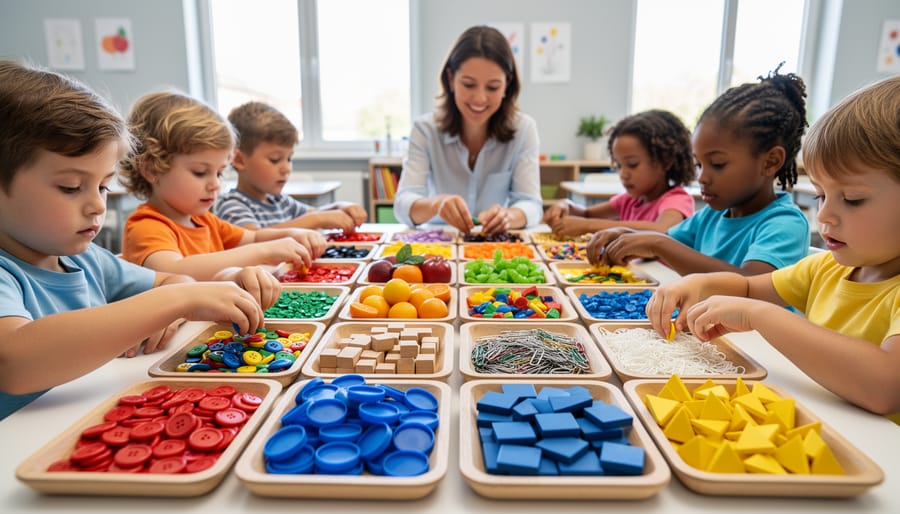
Grab a muffin tin, a few bowls, and a handful of everyday odds and ends: buttons, blocks, pom-poms, spoons, socks, bottle caps. Dump them in a pile and announce that your little scientist has a very important job to do.
Start simple. Ask your child to put all the red things in one cup and all the blue things in another. Sorting is how scientists make sense of the world. When kids group things by what’s the same and what’s different, they’re practicing classification, one of the earliest building blocks of STEM thinking.
Once that feels easy, try the “sort it a new way” challenge. Say, “Can you sort these a different way?” Maybe the buttons now go by size, or the blocks by shape. Then ask the magic question: “How did you decide?”
Listen closely to the answer. Words like “bigger,” “round,” “bumpy,” and “pointy” are growing vocabulary in action. If your child says, “These are all circles,” repeat it back with a smile and add a new word, like “curved.”
Try it now: sort five things by color, then regroup them by size. It takes about ten minutes and needs zero prep.
4. Robot Commander: A Screen-Free Coding Game
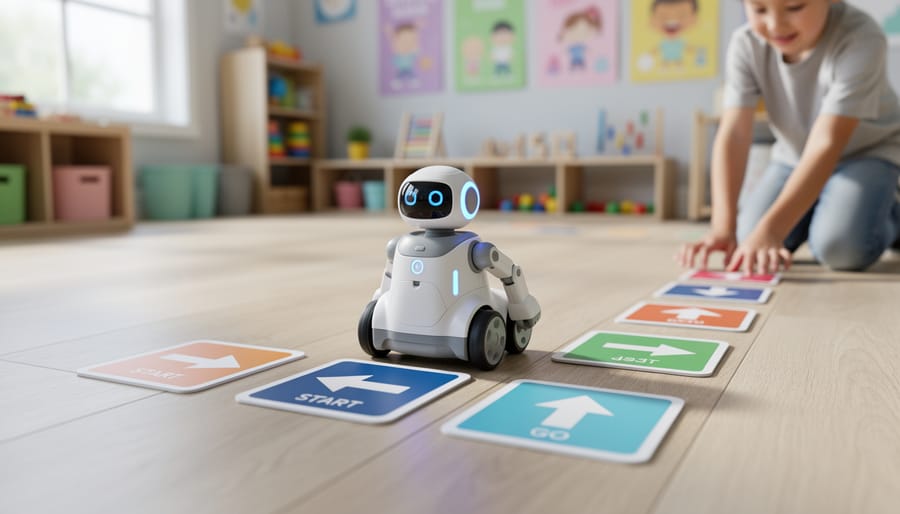
Here’s a game where your little one gets to be the boss of a robot. You (or a big brother or sister) play the robot, and your 4 year old gives the orders using simple arrow cards: a forward arrow, a turn arrow, and a jump arrow. Draw them on paper in thick marker and you’re ready.
A command is just one instruction, like “go forward.” A sequence is a bunch of commands lined up in order, like a recipe. Mix up the order and the robot ends up somewhere very different!
Try it now:
1. Place a goal on the floor, like a stuffed animal or a bowl of “robot fuel” (pom-poms).
2. Let your child lay out two or three arrow cards in a row.
3. Walk through the commands exactly as shown, nice and stiff and robot-y.
4. If you bump into the couch, giggle and say, “Oops, a bug! Let’s fix the sequence.”
Start with just two cards. Once that feels easy, add a third, then swap roles so your child becomes the robot.
That moment of fixing the sequence is early programming logic in action, no tablet needed. It’s also a gentle stepping stone toward beginner coding tools later on, when your child is ready to drag and drop commands on a screen.
5. Letter Sound Hopscotch: Move Your Body, Learn Your ABCs
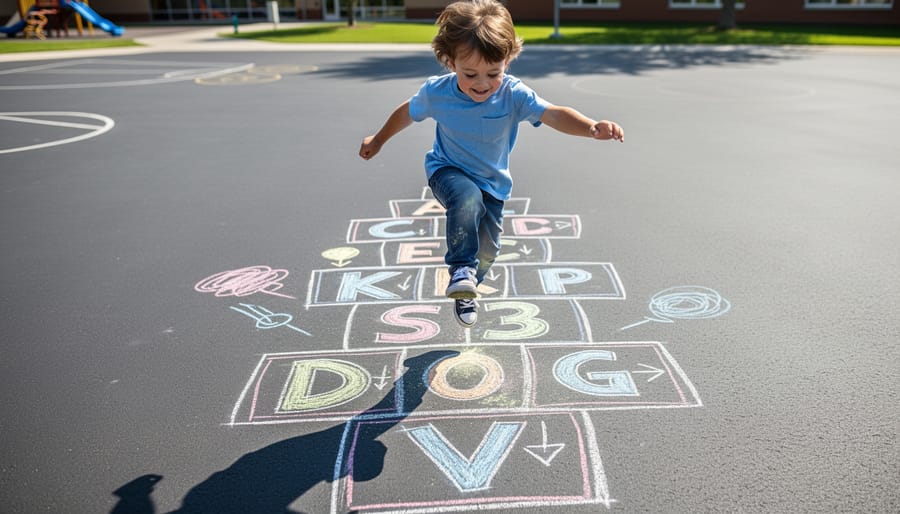
Got a wiggly four year old who can’t sit still for ABCs? This game lets those wiggles do the learning.
What you need: chalk for the driveway, or painter’s tape for the floor, plus a few small objects like a toy cat, a ball, and a spoon.
How to play:
1. Write or tape 6 to 8 big letters in a hopscotch path. Start with letters your child already knows, like the first letter of their name.
2. Call out a sound, like “mmm.” Your little hopper jumps to the letter M.
3. Next, hold up an object. “What sound does ball start with?” Hop to B!
4. Cheer every hop, even the wobbly ones.
Indoor option: No outdoor space? Write letters on sheets of paper and scatter them across the living room floor. Kids can tiptoe, hop, or leap from page to page. Tape the sheets down so nobody skids.
Say each letter’s sound, not just its name. “Buh” for B helps your child connect letters to the sounds in real words, which is the start of phonics (matching letters to the sounds they make).
Try it now: pick one letter, call out its sound, and see how fast your hopper can find it!
6. Build-a-Pattern Challenge: Block and Bead Puzzles
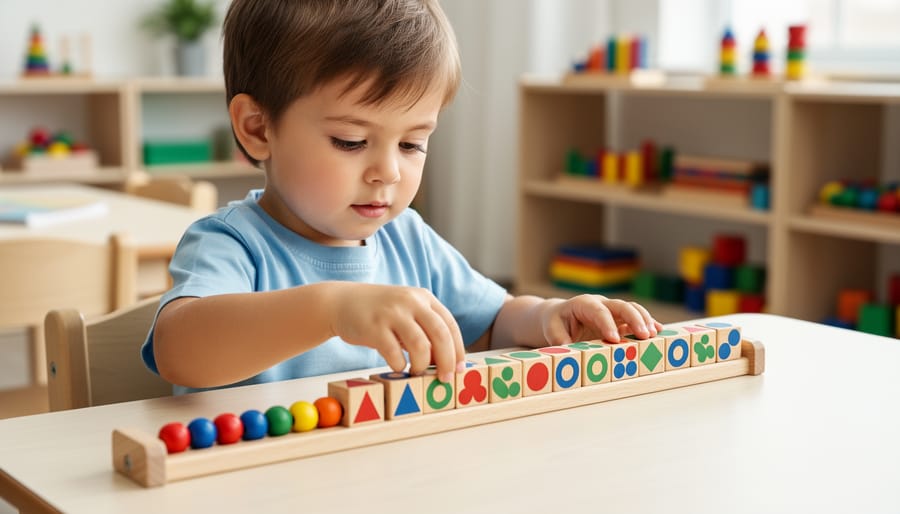
Patterns are everywhere, from stripes on a shirt to the beat of a song, and spotting them is one of the first big math skills your child can learn. Plus, it’s secretly a coding skill, because computers love patterns too!
What you need: blocks, large beads, or snap cubes in two or three colors.
Start by making a short pattern and asking your little learner to copy it. Then say, “What comes next?” and let them extend it. Once they get the hang of it, hand over the blocks and let them invent a pattern for you to solve. Kids love stumping a grown-up!
Try these levels:
– Easy: Two colors, repeating (red, blue, red, blue).
– Medium: Three colors (red, blue, yellow, red, blue, yellow), or patterns that use sounds, like clap-stomp-clap-stomp.
– Tricky: Patterns that grow (one red, two blue, three red) or ones with a missing piece they need to fill in.
Threading beads onto a string adds a fine motor workout, and building a long pattern takes real concentration. Keep sessions to 10 minutes or so, and celebrate every creative pattern, even the wobbly ones.
7. Kitchen Counter Measuring Lab: Pour, Scoop, and Compare
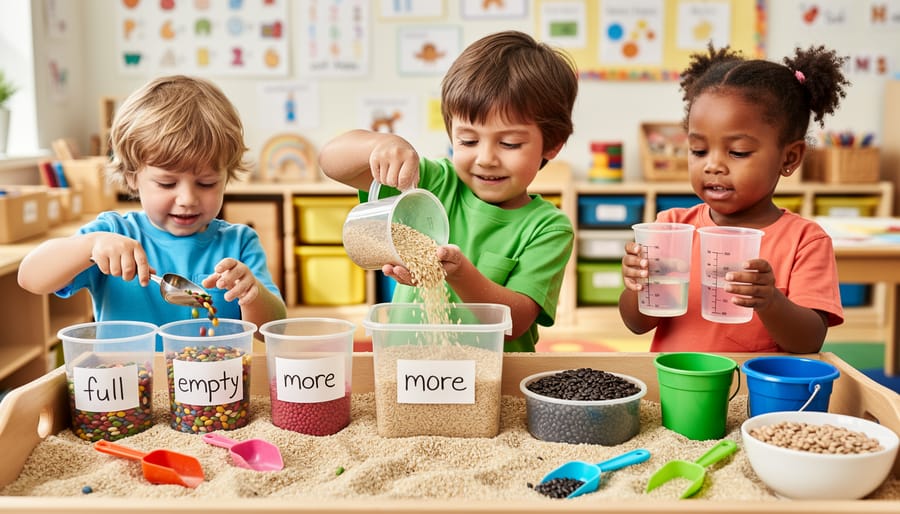
Set a tray on the counter, grab a few plastic cups, a big spoon, and a bowl of dry beans or water. Then ask the big question: which one holds more? Your little scientist will pour, scoop, and squint at the results with serious lab-coat energy.
Start simple. Let your child fill a small cup and dump it into a bigger one. Does it fit? Does it spill over? Words like full, empty, more, less, and equal pop up naturally here, so use them out loud as you play. Next, try a challenge: how many spoonfuls of beans does it take to fill the cup? Count together, then guess before testing a different cup.
This is cause-and-effect science in action. Tip the cup, and the water moves. Pack the beans tight, and fewer fit. If your child loves experiments like this, our list of STEM toy ideas shows where this curiosity can grow as they get older.
Mess tip: put everything on a rimmed baking sheet and keep a towel nearby. Water play is easiest at the sink, and beans are a choking hazard for tiny mouths, so stay close and keep play supervised.
8. Story Dice Adventures: Tell a Tale, One Roll at a Time
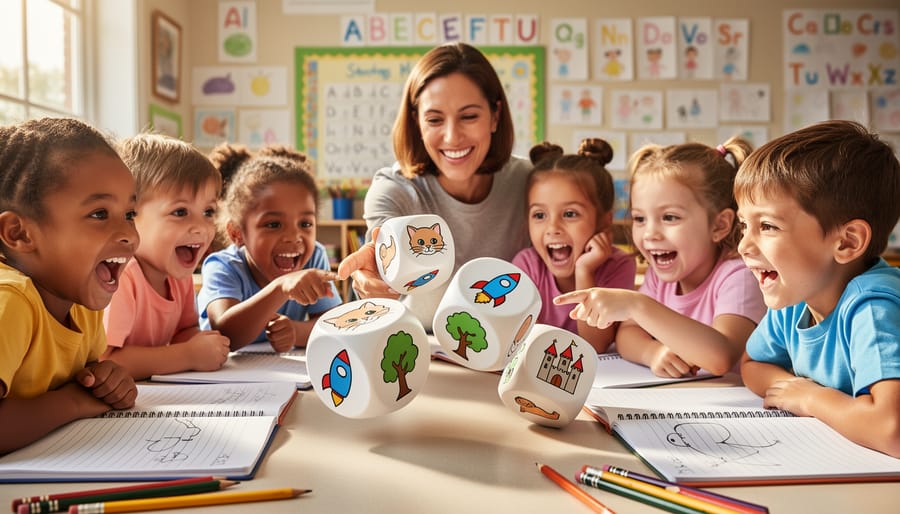
Roll a picture die, or pull a card from a bowl, and let the first image start the story. A dragon? A banana? A sleepy moon? Whatever lands, your 4 year old gets to decide what happens next.
Here’s how to play:
– Roll or draw one picture and say, “Once upon a time, there was a…”
– Let your child add the next part, then roll again for a surprise.
– Keep going for three or four rolls, then give the story an ending together.
Silly is the goal. A cow who drives a rocket is exactly the kind of idea that gets little ones talking. As your child tells the tale, they practice speaking in full sentences, using their imagination, and putting events in order (first, next, last). That’s called a sequence, and it’s a big building block for both reading and writing.
Grab a pencil and write the story down as they tell it, since your child isn’t writing yet, but they’ll love watching their words appear. Then hand over the crayons and let them draw the pictures. You’ve just made a tiny storybook!
This is also a gentle first step toward writing games for older kids. When your learner is ready for more, the ideas for 5 year olds in ideas for 5 year olds make a great next stop.
Gameschooling Questions Parents Ask About 4 Year Olds
How long should a gameschooling session last for a 4 year old?
Aim for 5 to 15 minutes per game. If your child is still giggling and engaged, keep going, and if they start to wiggle away, it’s perfectly fine to stop.
How many games should we play in a day?
One to three short games is plenty for most 4 year olds. Spread them out with snacks, outdoor play, and cuddly read-aloud time so learning never feels like a marathon.
What if my child loses interest halfway through?
That’s totally normal at this age! Try a silly twist, like making Robot Commander a dinosaur-stomp version, or save the game for tomorrow and pick something more active instead.
Do I need to buy special games or supplies?
Nope. Every idea on this list uses things you probably already have, like paper, crayons, blocks, bowls, and kitchen cups.
How do I know my child is really learning?
Listen for new words, watch for “I did it!” moments, and notice skills you didn’t have to teach twice. If your child can count a few objects, spot a rhyme, or copy a pattern, the learning is happening.
Your child isn’t behind if some days feel more giggly than “school-like.” At four, curiosity, movement, and play are the lessons, and a relaxed approach keeps learning something your little one looks forward to.
Your Gameschooling Takeaway: Keep It Short, Silly, and Fun
Play is how four-year-olds learn best, so you don’t need a perfect schedule to get started. Pick just one idea from the list today, maybe the Counting Treasure Hunt or Robot Commander, and see how it goes. Mix and match from there as your child’s interests change.
When your little learner is ready for more, come explore the homeschool games and activities waiting for you on BlackDog.
