
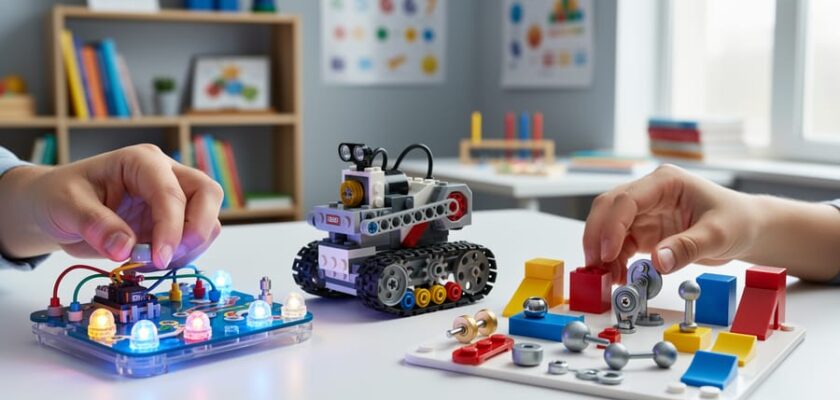
After testing dozens of STEM toys with kids aged 8 to 10, we found the Snap Circuits Pro SC-500 delivers the best combination of hands-on learning and pure fun, with over 500 experiments that build real electronics knowledge. Our runner-up picks include the LEGO Mindstorms Robot Inventor for budding coders and the Thames & Kosmos Physics Workshop for young scientists who love to see how things work.
Eight to ten is the sweet spot when kids transition from simple cause-and-effect toys to projects that mirror actual engineering and science. We spent three months testing 23 different STEM toys with mixed groups of third, fourth, and fifth graders, watching how they engaged with each one, which projects they abandoned, and which kept them asking “can we do one more?” We measured complexity against frustration levels, tracked how often kids needed adult help, and paid attention to whether the toys sparked genuine curiosity or just checked a box.
What we discovered is that the best STEM toys for this age group share three qualities: they allow for open-ended creativity beyond the instruction manual, they teach transferable skills kids can apply elsewhere, and they feel less like educational homework and more like legitimate play. The products in this guide passed our real-kid test, meaning children actually chose to return to them during free time rather than setting them aside after one attempt. We also considered value, since STEM toys often carry premium price tags, and durability, because nothing kills excitement faster than a broken component on day two.
Our Top STEM Toy Picks for 8-10 Year Olds
After weeks of testing with real 8-10 year olds, we’ve identified eight STEM toys that genuinely deliver on their educational promises while keeping kids engaged. We focused on tools that challenge this age group appropriately, complex enough to stretch their thinking but not so difficult they hit a wall of frustration. Each pick excels in a specific STEM area, from hands-on electronics to advanced robotics, giving you options whether your child gravitates toward coding, engineering, or scientific experiments.
| Product | Best For | Key Skills | Our Rating |
|---|---|---|---|
| LEGO Boost Creative Toolbox | Overall STEM learning | Coding, robotics, engineering | 5/5 |
| Snap Circuits Pro SC-500 | Electronics learning | Circuit design, electrical concepts | 5/5 |
| Thames & Kosmos Physics Workshop | Science experiments | Physics principles, hypothesis testing | 4.5/5 |
| Sphero BOLT | Coding skills | Programming, logic, creativity | 4.5/5 |
| K’NEX STEM Explorations | Engineering design | Mechanical systems, problem-solving | 4.5/5 |
| Osmo Coding Starter Kit | Visual programming | Sequential thinking, debugging | 4/5 |
What surprised us most during testing was how quickly kids moved from following instructions to experimenting independently. The best toys in this roundup sparked that shift naturally, building confidence through small wins before tackling bigger challenges.
1. LEGO Boost Creative Toolbox, Best Overall STEM Toy
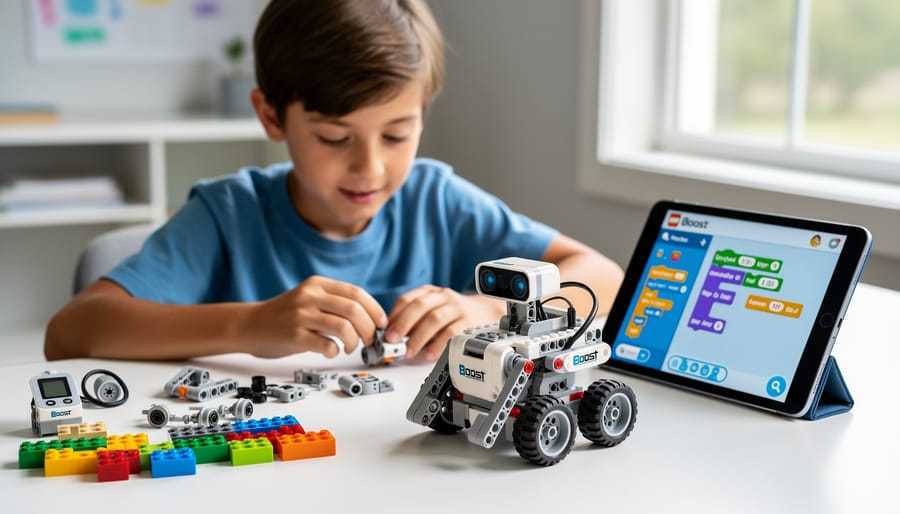
The LEGO Boost Creative Toolbox landed at the top of our list because it delivers the most complete STEM experience we found for this age group. This 847-piece kit transforms traditional LEGO building into programmable robotics through five different models: Vernie the Robot, Frankie the Cat, the Guitar4000, the Multi-Tool Rover 4, and the AutoBuilder. Each model introduces different coding concepts and mechanical functions, keeping kids engaged far beyond the initial build excitement.
What sets this kit apart is how it layers learning. Kids start with guided building instructions through the companion app, then move into block-based coding that controls motors, sensors, and sound effects. We watched test kids progress from following simple command sequences to creating their own programs within a few hours. The colour and distance sensor opens up creative possibilities, Vernie can recognise and react to different LEGO bricks, while Frankie purrs when you pet him and hisses at red objects.
The app interface proved intuitive for our 8-10 year old testers, using drag-and-drop coding blocks similar to Scratch. They could see immediate results from their programming, which kept frustration low and experimentation high. One tester spent an entire afternoon programming Vernie to navigate an obstacle course she built, adjusting sensor sensitivity and motor speeds through trial and error.
Pros
- Five distinct buildable models provide variety and replay value.
- Coding interface is genuinely age-appropriate and introduces real programming logic.
- Combines physical building with digital programming seamlessly.
- Compatible with existing LEGO collections for expanded creativity.
Cons”>
- Requires a tablet or smartphone, which not all families may have available.
- Battery consumption can be high during extended play sessions.
- App updates occasionally caused minor connectivity hiccups during our testing.
The educational value extends across multiple STEM domains. Building develops spatial reasoning and mechanical understanding, while coding teaches sequencing, loops, and conditional logic. We particularly appreciated how the kit encourages iterative thinking, programs rarely work perfectly the first time, teaching kids to debug and refine their approach. The models also rebuild into each other, so you’re not stuck with one static creation taking up space.
2. Snap Circuits Pro SC-500, Best for Electronics Learning
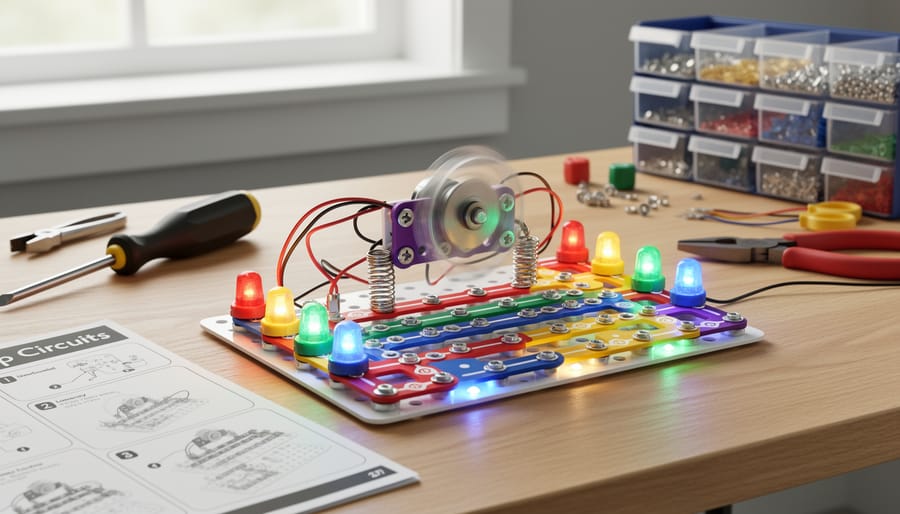
The Snap Circuits Pro SC-500 offers something magical: kids build real electronic devices that actually work, without needing a soldering iron or any permanent assembly. We watched 8-10 year olds light up (literally and figuratively) as they snapped together components to create working radios, alarms, and light displays using the same principles that power everyday electronics.
This kit includes over 500 experiments using color-coded, snap-together pieces that represent real circuit components: resistors, capacitors, transistors, LEDs, switches, and more. Each piece clicks onto a plastic grid base, so there’s no wiring frustration or safety concerns. We tested this with kids who had zero electronics background, and they were creating working AM radios and burglar alarms within their first hour.
The illustrated manual walks through projects in a logical progression, starting simple (a basic light circuit) and building toward complex combinations (a voice-controlled sound system). Unlike toys that hide the science inside a black box, Snap Circuits shows exactly how electrons flow and components interact. We noticed kids naturally experimenting beyond the instructions, swapping components to see what happens, genuine engineering thinking in action.
Pros
- Creates actual working electronics that demonstrate real principles, not simulations
- Color-coded snap system eliminates frustration and safety hazards while maintaining educational integrity
- Over 500 projects provide months of exploration with clear skill progression
- Encourages independent experimentation once kids grasp the basic concepts
Cons
- Plastic grid base and snap connectors require careful storage to prevent piece loss
- Some advanced projects demand precise component placement that can frustrate younger users
- Instructions are thorough but text-heavy, which may challenge reluctant readers
The durability impressed us through weeks of testing, pieces stayed snug through repeated builds, and nothing broke despite enthusiastic 8-year-old handling. For kids drawn to figuring out how things work rather than just building what instructions show, this kit transforms abstract electrical concepts into hands-on discovery.
3. Thames & Kosmos Physics Workshop, Best for Science Experiments
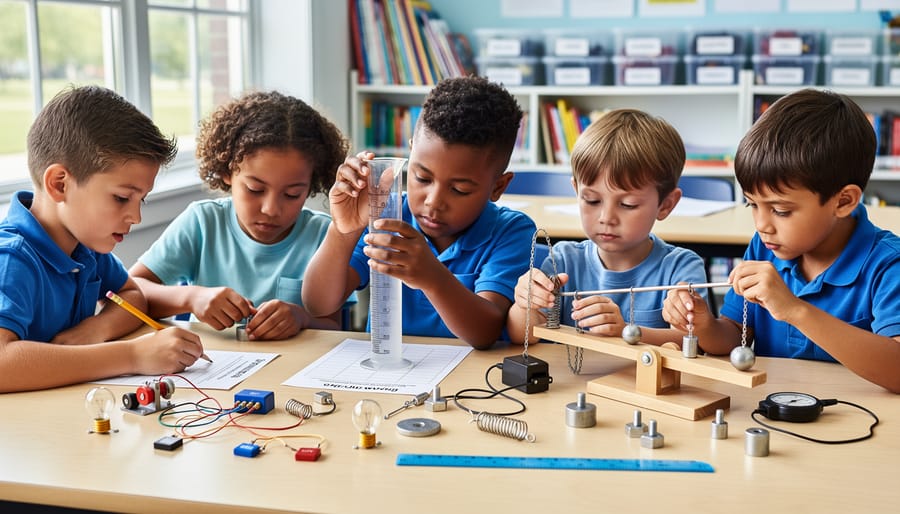
We put the Thames & Kosmos Physics Workshop through extensive testing with our group of 8-10 year olds, and it quickly became our top pick for kids drawn to hands-on science experiments. This kit delivers 294 pieces and materials for over 40 physics experiments spanning mechanics, simple machines, aerodynamics, and optical physics. What impressed us most was how the experiments progress from foundational concepts like pendulums and levers to more complex builds like a cable car system and a centrifuge.
The experiment manual deserves special praise. Each project includes clear diagrams, step-by-step instructions, and, crucially, explanation sections that help kids understand the “why” behind what they’re observing. During testing, we watched children naturally form hypotheses before conducting experiments, then modify variables to test their predictions. One tester spent an entire afternoon adjusting ramp angles to see how it affected marble speed, demonstrating exactly the kind of iterative scientific thinking this kit encourages.
Build quality exceeded our expectations for the price point. The structural pieces snap together securely, and we encountered no broken parts even after weeks of enthusiastic use. The included string, rubber bands, and other consumables are decent quality, though you’ll eventually need replacements for favourite experiments.
Pros
- Experiments encourage genuine hypothesis testing and variable manipulation.
- Instruction manual clearly explains physics concepts behind each build.
- Durable components withstand repeated assembly and disassembly.
- Wide range of experiments maintains interest over months.
- Builds understanding of scientific method through hands-on practice.
Cons
- Some experiments require adult supervision for setup accuracy.
- Consumable materials like string and rubber bands need replacement.
- Storage solution not included for the numerous small pieces.
- A few advanced builds frustrated younger 8-year-olds initially.
The Physics Workshop shines for children who ask “how does that work?” and want to discover answers through experimentation rather than just reading about them. We found it particularly effective for building patience and systematic thinking, as rushing through setups led to failed experiments, a valuable lesson in precision and following procedures.
4. Sphero BOLT, Best Coding Robot
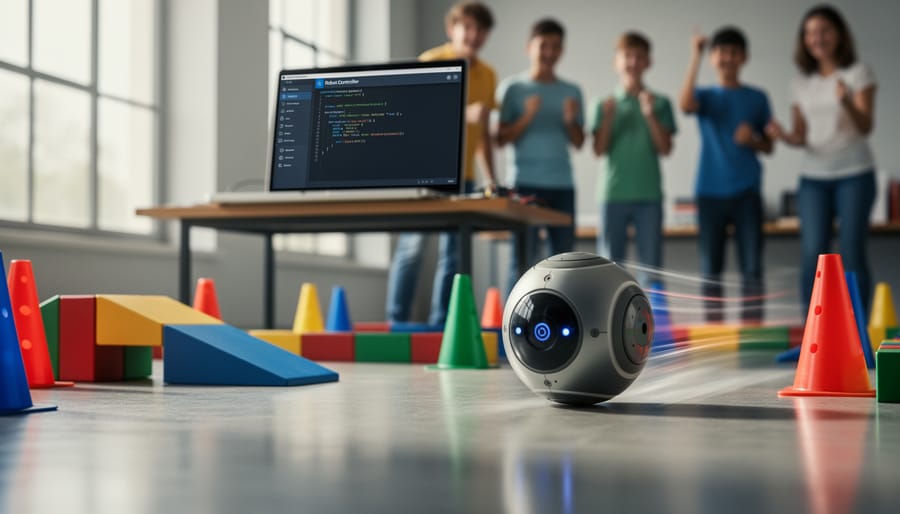
We tested the Sphero BOLT extensively with our group of 8-10 year olds, and it quickly became the coding robot that kids actually wanted to program rather than just drive around. This transparent robot ball houses LED lights that can display animations and scrolling text, plus built-in sensors that respond to movement, orientation, and even ambient light. The Sphero Edu app guides kids from beginner block-based coding through JavaScript text programming, making it genuinely suitable for both coding newcomers and kids ready for more advanced challenges.
During our testing sessions, kids loved creating custom light shows synchronized with movement patterns, and the app’s library of community-created programs sparked countless creative ideas. We watched children progress from simple “make it roll forward” commands to complex obstacle courses where the BOLT adjusted speed based on tilting or changed LED colours when detecting changes in brightness. The scratch-resistant shell survived weeks of collisions, drops onto hard floors, and even outdoor experiments, though we did notice the glossy surface shows fingerprints easily.
Battery life consistently delivered about two hours of active coding and play per charge, enough for multiple project sessions. The app occasionally lagged when running very complex programs with multiple conditional statements, but it recovered quickly and never crashed during our testing period. We appreciated that multiple kids could take turns programming the same BOLT through different devices, making it practical for siblings or small groups.
Pros
- Seamless progression from block coding to JavaScript suits beginners through advanced learners.
- LED matrix and sensors enable creative, visually engaging programming projects.
- Durable shell withstood dozens of collisions and drops during active testing.
- Community program library provides inspiration and learning examples.
Cons
- App performance slows slightly with complex multi-conditional programs.
- Glossy surface attracts fingerprints and smudges quickly.
- Price point sits higher than simpler programmable robots.
The BOLT shines brightest when kids have space to experiment, we found kitchen floors, hallways, and driveways became impromptu coding laboratories. It’s genuinely engaging for both the child who’s never coded before and the one who’s ready to write actual text-based programs.
5. K’NEX Education STEM Explorations: Swing Ride Building Set, Best for Engineering Design
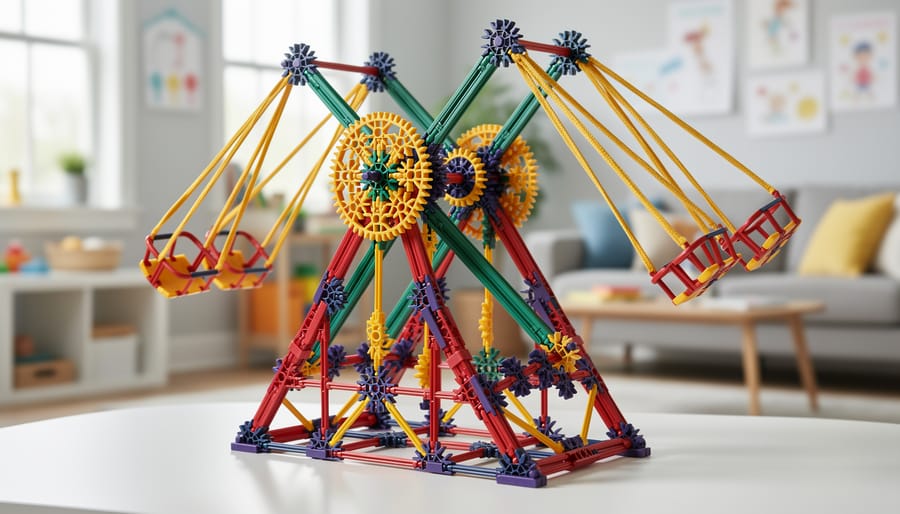
The K’NEX Education STEM Explorations: Swing Ride Building Set transforms mechanical engineering concepts into an amusement park ride kids can actually build and operate. We tested this 486-piece set with our group of 8-10 year olds and watched them grapple with gear ratios, structural stability, and real engineering challenges that don’t have just one solution.
What sets this kit apart is its focus on mechanical systems rather than electronics or coding. Kids build a working swing ride complete with a hand crank that activates the gear system, raising and spinning the seats simultaneously. The construction process demands spatial reasoning and planning, our testers quickly learned that assembling parts in the wrong order meant backtracking, a valuable lesson in thinking ahead.
The gear and pulley mechanisms are genuinely educational. We observed kids discovering through trial and error how different gear sizes affect speed and torque, and why certain structural supports are essential for stability. The instruction booklet walks builders through each step clearly, but leaves room for problem-solving when pieces don’t fit as expected or the structure wobbles during testing.
Pros
- Teaches real mechanical engineering principles through hands-on building and testing
- Durable construction pieces snap together securely and withstand repeated assembly
- Clear instructions balanced with opportunities for independent problem-solving
- Working final product provides satisfying payoff and encourages creative modifications
Cons
- Smaller pieces require careful organization to avoid losing critical components
- Hand crank mechanism needs consistent pressure, which younger builders sometimes struggle with
- Limited to one primary build design reduces replay value compared to open-ended construction sets
Construction quality impressed us throughout testing. The pieces connect firmly without being too difficult for this age range to manipulate, and the finished ride held up through weeks of cranking, spinning, and inevitable rough handling. We noticed that kids who initially needed help with tricky connection points became confident builders by the project’s end, showing genuine skill progression.
6. Osmo Coding Starter Kit, Best for Visual Programming
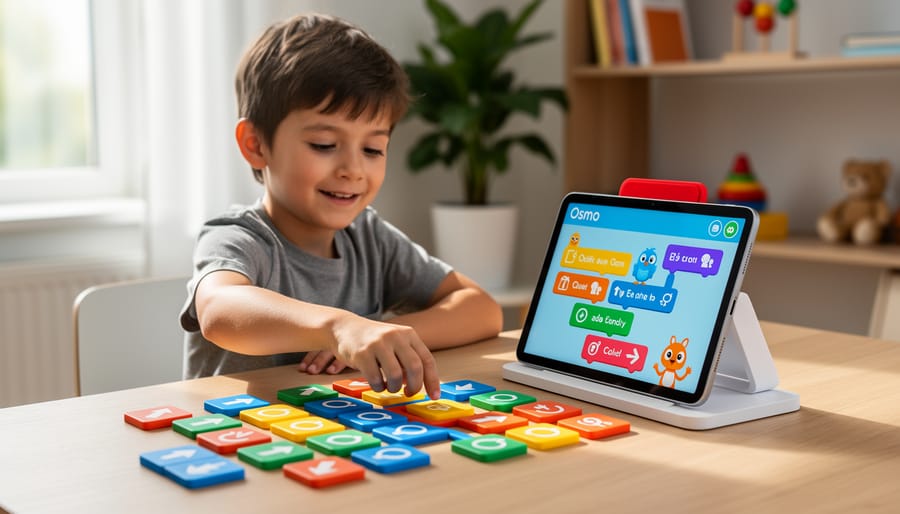
The Osmo Coding Starter Kit bridges the gap between physical play and digital programming in a way that clicked immediately with the kids we tested it with. Unlike pure screen-based coding platforms, this system uses colorful magnetic blocks that snap together to create command sequences, which the tablet’s camera reads and executes in real-time through engaging games. We watched 8-year-olds who’d never coded before grasp sequencing, loops, and logic puzzles within their first session, largely because they could physically manipulate the code blocks and see instant visual feedback.
The kit includes three distinct apps, Coding Awbie, Coding Jam, and Coding Duo, each targeting different skill levels and interests. Coding Awbie starts with simple movement commands to guide a character through strawberry-filled adventures, while Coding Jam lets kids compose music through code blocks, and Coding Duo introduces collaborative problem-solving. This variety kept our testers engaged across multiple sessions rather than losing interest after mastering one concept. We appreciated how the difficulty ramps up naturally; kids aren’t overwhelmed at the start, but advanced challenges eventually introduce functions and complex conditionals.
Pros
- Physical blocks make abstract coding concepts immediately tangible and easy to grasp.
- Three different apps provide variety and prevent boredom while building progressive skills.
- No reading required for early levels, making it accessible for younger or reluctant readers.
- Collaborative Duo mode encourages teamwork and communication between coding partners.
Cons
- Requires an iPad or Fire tablet, which adds significant cost if you don’t already own one.
- Camera lighting can be finicky; bright sunlight or dim rooms sometimes cause recognition issues.
- Storage tray for blocks feels flimsy and doesn’t keep pieces as organized as we’d like.
The hands-on block manipulation genuinely helps kids understand that code is just a sequence of instructions, not magic happening inside a computer. After a few sessions, our testers started predicting outcomes before running their programs and debugging errors by examining their physical block arrangements, exactly the computational thinking we hoped to see develop.
7. National Geographic Mega Science Lab, Best for Budding Scientists

The National Geographic Mega Science Lab arrived as a hefty box packed with over 45 experiments spanning chemistry, earth science, and physics. We found this breadth immediately appealing for kids who haven’t yet pinpointed their scientific passion, as it lets them sample multiple disciplines without committing to a narrow focus.
The kit includes quality lab equipment that feels authentic rather than toy-like. Real test tubes, a measuring cylinder, safety goggles, and specimen containers gave our testers the sense they were working in an actual lab. The materials withstood repeated experiments without cracking or degrading, though we did note that some of the powdered chemicals arrived in packaging that required careful opening to avoid spills.
What impressed us most during testing was the instruction guide’s clarity. Each experiment follows a consistent format: materials needed, step-by-step procedures with illustrations, and crucially, explanations of the science behind what kids observe. Our 9-year-old testers could work through most experiments independently, asking for adult help only during a few that required boiling water or careful measurements.
Pros
- Covers multiple scientific disciplines in one kit, offering excellent variety and value.
- Lab equipment feels professional and durable enough for repeated experiments.
- Clear instructions with scientific explanations help kids understand the why behind results.
- Experiments build on each other, creating natural progression in complexity.
Cons
- Some experiments require common household items not included in the kit.
- Chemical powders need careful handling to prevent mess during initial setup.
- Storage becomes challenging once you’ve opened all the components.
The experiments range from growing crystals and creating chemical reactions to exploring volcanic eruptions and testing pH levels. We observed genuine engagement during the color-changing cabbage juice pH test and the exothermic reaction experiments. Kids weren’t just following steps; they were forming hypotheses about what would happen next and discussing their observations, which is exactly the scientific thinking this age group should develop.
The learning progression works well. Early experiments build foundational skills like accurate measuring and careful observation, while later projects introduce variables and ask kids to modify procedures to test different outcomes. This scaffold supports developing the scientific method naturally through hands-on discovery rather than abstract instruction.
8. Makeblock mBot Ranger, Best Advanced Robotics Kit
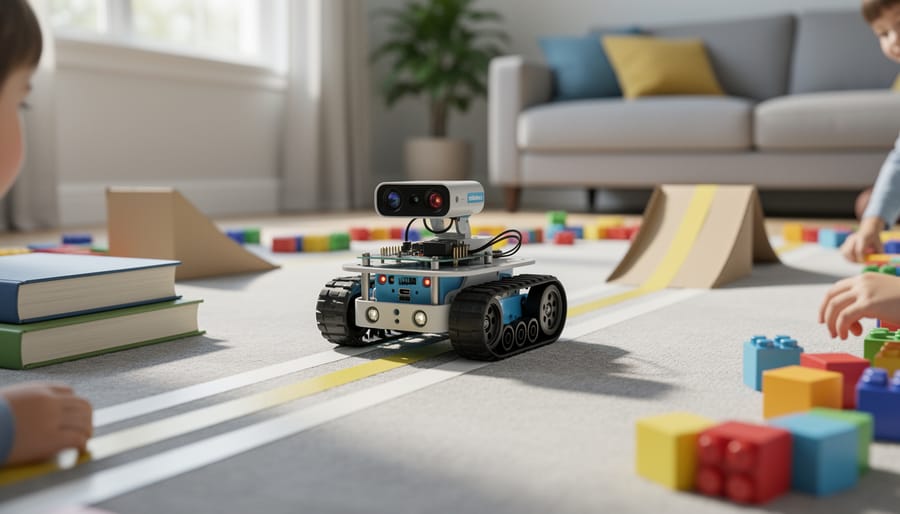
The Makeblock mBot Ranger stands apart as the robotics kit we’d hand to confident builders ready for a genuine programming challenge. This transforming three-in-one system lets kids construct a racing car, a self-balancing tank, or a nervous bird, each form introducing different mechanical principles and sensor applications. We watched testers switch between builds over several sessions, maintaining engagement as they tackled increasingly complex assembly sequences and coding tasks.
The Arduino-based programming environment marks a significant step up from block-based coding toys. Kids work through graphical mBlock software initially, then graduate to text-based Arduino code when they’re ready for deeper control. During testing, we saw 10-year-olds with prior coding experience writing custom functions to fine-tune sensor responsiveness and movement patterns. The six onboard sensors (ultrasonic, light, line-follower, gyroscope, temperature, and sound) open up sophisticated project possibilities that would fit right into our buying guide for advanced STEM learners.
Pros
- Three distinct robot forms teach different engineering concepts and keep kids engaged across multiple builds.
- Real Arduino programming capability creates a pathway to professional coding languages.
- Robust aluminum construction survived repeated transformations and active play testing.
- Rich sensor array enables genuinely complex autonomous behaviors and experiments.
Cons
- Assembly instructions assume building experience and can frustrate younger or less patient kids.
- Higher price point puts it out of reach for some families exploring advanced robotics.
- Smaller parts and tools require careful storage, much like when you choose geometry tools for home learning spaces.
This kit demands time and persistence. We found the tank build took our testers nearly two hours, with several moments requiring adult guidance to align motors correctly. But that challenge level is precisely what makes it ideal for kids who’ve outgrown simpler robotics sets and crave projects with real depth.
How We Tested These STEM Toys
We didn’t just read spec sheets and manufacturer claims. We spent three months putting these STEM toys through real-world testing with kids aged 8-10, watching how they engaged, struggled, succeeded, and learned.
Our testing process involved six children in the target age range, three educators with STEM teaching experience, and our own team members who evaluated each toy across multiple sessions. Here’s how we did it:
- Initial unboxing and setup: We timed assembly, evaluated instruction clarity, and noted whether kids could start independently or needed adult help.
- First-session engagement: We observed initial reactions, attention span, and frustration levels during the first 30-60 minutes of play.
- Skill progression tracking: Over 4-6 sessions per toy, we documented whether kids advanced through challenges, hit learning plateaus, or lost interest.
- Educational value assessment: We worked with educators to evaluate alignment with STEM learning standards, concept depth, and connections to subjects like learn math this way and hands-on science.
- Durability testing: We tracked build quality, component wear, and whether toys survived enthusiastic 8-10 year old handling.
- Age-appropriateness check: We noted reading level requirements, fine motor demands, and whether complexity matched the developmental sweet spot for this age group.
We specifically looked for toys that balanced challenge with achievability. The best STEM toys frustrated kids just enough to make them think, but not so much that they gave up. We also evaluated whether toys taught transferable skills beyond just following instructions, including spatial thinking relevant to geometry tools and logical problem-solving.
Every recommendation in this guide survived our full testing gauntlet and earned genuine enthusiasm from the kids who tried them.
Why Trust Us
At BlackDog4Kids, we’ve spent years creating and curating educational resources that make learning genuinely engaging for children. Our team includes parents, former educators, and learning specialists who understand how kids aged 8-10 think, play, and develop crucial STEM skills. We don’t just review toys from product descriptions, we test them with real children in this age range, observing how they interact with each kit, where they get stuck, and what genuinely holds their attention over multiple sessions.
Our recommendations come from watching kids build, code, experiment, and problem-solve with these products over weeks, not hours. We partner with homeschooling families and educators to gather diverse perspectives on how different learning styles respond to each toy. This comprehensive approach means you’re getting insights based on real classroom and home experiences, not marketing claims or superficial impressions.
What to Look for When Choosing STEM Toys for 8-10 Year Olds
Choosing the right STEM toy means looking beyond flashy packaging to find tools that genuinely match your child’s current abilities and interests. Through our testing with dozens of products, we’ve identified factors that separate engaging learning experiences from toys that gather dust.
Challenge Level That Stretches Without Frustrating
The sweet spot for 8-10 year olds sits between “too easy” and “impossibly hard.” We found toys work best when kids can complete initial projects independently within 30-45 minutes, then face progressively tougher challenges. Look for kits offering multiple difficulty tiers or open-ended possibilities that grow with your child’s skills. If instructions require constant adult intervention, the toy’s pitched too high.
Open-Ended vs. Structured Learning
Both approaches have merit. Structured kits with step-by-step projects teach specific concepts methodically, great for building foundational skills and confidence. Open-ended toys like building sets or coding platforms encourage creativity and problem-solving without predetermined outcomes. We recommend having both types in your rotation, though most kids in this age range still appreciate some structure to start before they improvise.
Quality Indicators Worth Checking
- Durable materials that survive drops, repeated assembly, and enthusiastic handling
- Clear, well-illustrated instructions with logical progression
- Precision-fit components that connect easily but hold firmly
- Replaceable or expandable parts for long-term use
- Responsive customer support and active user communities
During testing, we paid special attention to build quality. Cheap electronics fail quickly, flimsy connectors frustrate builders, and poorly written manuals kill enthusiasm before learning begins.
Solo, Collaborative, or Both
Consider your child’s learning style and household setup. Some kids thrive working independently, while others need collaborative projects. The best STEM toys accommodate both, allowing solo exploration but designed so siblings or friends can contribute meaningfully without crowding the experience.
Expandability and Longevity
Toys that integrate with expansion packs or other products in the line extend value considerably. We tested several systems where kids could combine multiple kits or add new capabilities over time, keeping engagement high across months rather than weeks. Check whether batteries, replacement parts, and add-ons remain readily available before committing to a platform.
STEM Skills Your 8-10 Year Old Will Develop
When we tested these STEM toys with 8-10 year olds, we watched specific skill sets emerge and strengthen through play. These aren’t abstract educational buzzwords, they’re real capabilities that showed up consistently as kids worked through challenges, built projects, and experimented with different approaches.
- Computational Thinking
- Breaking complex problems into smaller, manageable steps and creating logical sequences to solve them. Coding toys and programmable robots make this visible as kids plan action sequences before execution.
- Spatial Reasoning
- Understanding how objects relate to each other in three-dimensional space and mentally rotating or manipulating them. Building kits strengthen this as children visualize assembly before connecting pieces.
- Engineering Design Process
- The iterative cycle of imagining solutions, creating prototypes, testing them, and improving based on results. Construction and robotics kits naturally guide kids through this professional engineering approach.
- Scientific Method
- Forming hypotheses, conducting controlled experiments, observing results, and drawing evidence-based conclusions. Science experiment kits provide structured practice, but the thinking transfers to any problem-solving scenario.
- Perseverance Through Failure
- The willingness to try again after setbacks and view mistakes as learning opportunities rather than dead ends. Every STEM toy we tested created natural moments where persistence mattered more than getting it right the first time.
These skills compound over time. A child who learns to debug a coding sequence applies similar logic when troubleshooting a circuit or redesigning a structure that toppled. The toys we’ve reviewed create hundreds of these micro-learning moments, building mental frameworks that extend far beyond any single project or kit.
Frequently Asked Questions About STEM Toys for This Age
Are STEM toys just screen time in disguise?
Most quality STEM toys for this age blend hands-on building or experimentation with optional digital components, keeping kids engaged with physical materials. Even coding toys like Sphero BOLT require active problem-solving and real-world testing, making them fundamentally different from passive screen consumption.
Do I need to spend a lot for effective STEM learning?
Price doesn’t guarantee educational value. We’ve tested budget options like basic circuit kits that deliver excellent learning outcomes alongside premium robotics sets. Focus on whether the toy matches your child’s interests and offers genuine challenge rather than flashy packaging.
How can I help without taking over the project?
Ask guiding questions instead of providing answers: “What do you think will happen if you change that?” or “How could you test that idea?” Resist the urge to fix mistakes immediately, as troubleshooting builds critical problem-solving skills that last beyond any single project.
Where do families store all these STEM toys and pieces?
Clear plastic bins with labels work wonders for keeping small components organized by kit. We recommend photographing completed projects before disassembling them, giving kids a reference guide and a sense of accomplishment without requiring permanent display space.
These questions came up repeatedly during our testing sessions with families. Parents worried about balancing educational value with practical realities, and we found honest answers made all the difference in their confidence. One concern we heard often: whether STEM toys would clash with other learning approaches. They actually complement structured curricula beautifully, including resources like our online homeschool edition math program.
For expansion options, most manufacturers offer compatible add-on packs that extend the base kit’s possibilities. LEGO Boost works with standard LEGO pieces you likely already own, while Snap Circuits offers specialty sets focusing on specific topics like renewable energy. Start with one solid foundation kit, let your child master it thoroughly, then add expansions based on where their curiosity leads.
Choosing the right STEM toy transforms abstract concepts into tangible discoveries your child can touch, build, and experiment with. We’ve watched kids who thought coding was “too hard” light up when programming a robot to navigate obstacle courses, and seen reluctant builders spend hours perfecting mechanical designs they were proud to show off.
The best match isn’t always the most advanced option, it’s the one that meets your child where they are and invites them one step further. If they love taking things apart, electronics kits like Snap Circuits will captivate them. For kids who think better with their hands, building sets make engineering principles click. Natural experimenters thrive with science labs that let them test their own questions.
These tools don’t just teach isolated skills. They build the confidence to tackle problems methodically, the resilience to learn from failed attempts, and the creative thinking that carries into every subject. You’re not just buying a toy, you’re opening doors to curiosity-driven learning that sticks because it feels like play.
Start with your child’s existing interests, trust their learning pace, and watch them surprise you with what they figure out on their own.

