

Transform math anxiety into math confidence by choosing online programs that adapt to your child’s pace and learning style. Digital math tools turn abstract concepts into interactive adventures—fractions become pizza slices to divide, multiplication tables transform into games, and geometry springs to life through virtual building blocks.
Match your program to your child’s needs by testing free trials before committing. Look for platforms offering visual demonstrations for young learners who need to see concepts in action, practice problems that adjust difficulty automatically, and immediate feedback that celebrates progress while gently correcting mistakes. The best programs feel like play while building genuine mathematical understanding.
Set up a simple daily routine: fifteen focused minutes beats an hour of frustration every time. Your role shifts from teacher to guide—you don’t need to know calculus to help your second-grader master addition. Quality online programs handle the instruction while you provide encouragement, monitor progress dashboards, and celebrate achievements.
Trust that effective math learning happens differently than you remember from school. Today’s interactive tools use color, sound, and movement to make abstract ideas concrete. Your kindergartener can grasp mathematical thinking through pattern games. Your fifth-grader can explore algebraic concepts through visual puzzles. The key is finding programs that turn “I can’t do math” into “Show me another problem!”
Online homeschool math succeeds when you embrace its flexibility, trust proven programs to guide instruction, and remember that your support matters more than your math expertise.
Why Online Math Works Better for Homeschoolers
Online math platforms bring something magical to the homeschool table: they transform learning into an adventure that adjusts to your child’s unique journey. Imagine having a patient tutor available 24/7 who never gets tired and celebrates every breakthrough with confetti and encouraging messages!
One of the biggest game-changers is self-paced learning. Your early bird can tackle fractions at 7 a.m., while your night owl explores geometry after dinner. No more rushing through concepts before they click or waiting while others catch up. Each child moves forward when they’re truly ready, building confidence along the way.
Here’s where the tech really shines: research shows instant feedback improves outcomes significantly. When your child solves a problem, they discover immediately whether they’ve mastered it. Wrong answer? The program often shows exactly where the mistake happened, turning errors into learning opportunities rather than frustrations. No more waiting until evening when you grade worksheets together and neither of you remembers the thought process!
Visual learners rejoice because online platforms paint math concepts in vivid colors and animations. Fractions become pizza slices. Multiplication transforms into arrays of bouncing stars. Suddenly, abstract ideas make sense because kids can see them, touch them through interactive screens, and manipulate them in ways paper worksheets never allowed.
For parents worried about teaching higher-level math, here’s your sigh of relief: adaptive learning technologies personalize education by adjusting difficulty automatically. The program becomes the math expert, identifying gaps and providing targeted practice while you focus on being the cheerleader and guide.
Different learning styles? Online platforms have you covered. Visual thinkers get diagrams. Hands-on learners interact with virtual manipulatives. Logical processors follow step-by-step demonstrations. Your curriculum adapts to your child, not the other way around, making math time less stressful for everyone involved.
What Makes a Great Online Math Program
Finding the perfect online math program might feel like searching for a magic key, but the good news is there are some clear signposts to guide you! Think of it as assembling your child’s dream learning adventure—certain ingredients make all the difference.
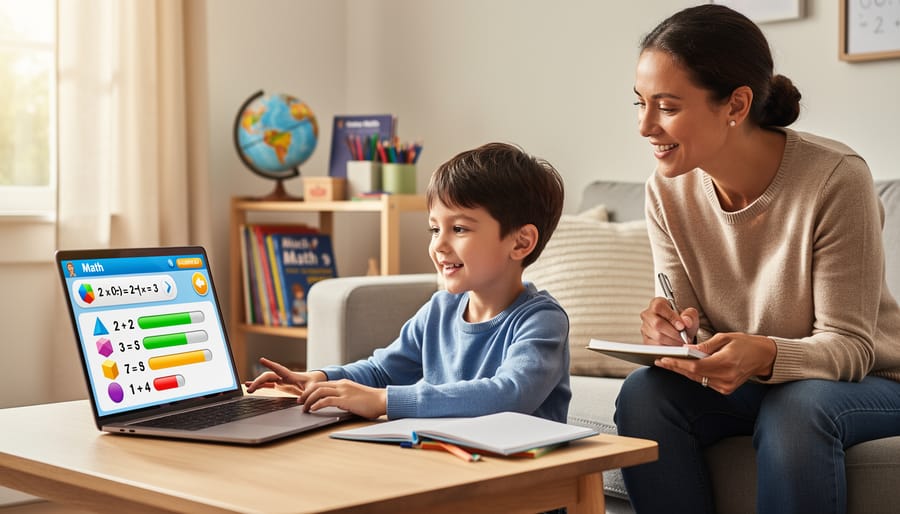
First, keep an eye out for an engaging, kid-friendly interface. Does the platform sparkle with colorful graphics and characters that make your little mathematician smile? The best programs feel less like homework and more like play, with interactive games and animations that turn abstract concepts into touchable, clickable fun. If your child actually wants to open the program, you’re already winning!
Progress tracking is your secret superhero tool. Look for programs that show you exactly where your child excels and where they might need extra practice. Clear dashboards, skill maps, and regular reports help you celebrate victories and spot challenges before they become frustrations. This transparency takes the guesswork out of homeschooling math.
Curriculum alignment matters too, especially if you’re following specific homeschool standards or want your child to stay on track with traditional milestones. Check whether the program covers essential skills like number sense, geometry, and problem-solving in a logical sequence.
Finally, seek that magical balance between educational rigor and genuine enjoyment. The sweetest spot is where learning feels challenging enough to spark growth but fun enough to keep motivation high. Programs that blend STEM concepts with creative problem-solving activities help children build both confidence and capability, turning “I can’t do math” into “Watch what I can do!”
Different Types of Online Math Tools

Interactive Math Games and Activities
Who says math practice has to feel like work? Some of the best online math platforms turn learning into pure fun! These clever sites disguise essential math skills as games, puzzles, and adventures that kids actually beg to play.
Platforms like Prodigy Math transform math practice into an epic fantasy quest where children battle monsters and collect treasures by solving problems. Each correct answer helps them level up their character and explore new worlds. Cool Math Games offers hundreds of brain-training puzzles that sneak in logic, patterns, and number sense while kids think they’re just playing.
For younger mathematicians, ABCmouse and Starfall use colorful animations and friendly characters to teach counting, shapes, and basic operations. Kids click, drag, and explore their way through math concepts without even realizing they’re learning.
SplashLearn combines game-based rewards with comprehensive curriculum coverage, making it perfect for parents who want fun mixed with serious skill-building. Meanwhile, Math Playground offers strategy games and logic puzzles that challenge older elementary students to think critically.
These playful platforms work wonders for worksheet-resistant learners. When math feels like playtime, children practice longer, complain less, and actually absorb more. The secret ingredient? They’re having too much fun to notice they’re becoming math whizzes!
Structured Curriculum Programs
Imagine having a friendly math teacher available 24/7, guiding your child step-by-step through everything from counting acorns to solving clever puzzles! That’s exactly what structured curriculum programs offer. These complete online packages cover all the Common Core math standards for your child’s grade level, wrapping lessons, practice exercises, and assessments into one delightful bundle.
Think of these programs as your child’s mathematical adventure map. Each lesson builds on the last, creating a clear path from addition basics to multiplication mastery. Your young mathematician won’t just watch videos—they’ll solve interactive problems, earn virtual badges, and celebrate small victories along the way. The best part? Built-in assessments help you spot exactly where your child shines and where they might need extra practice.
Popular programs like Khan Academy Kids, IXL, and Time4Learning offer colorful interfaces that feel more like games than textbooks. You’ll appreciate the automatic grading and progress reports that show you exactly what your child is learning, while they’ll love the engaging characters and reward systems that make math feel like playtime, not work time.
Practice and Drill Platforms
Think of practice platforms as your child’s personal math gym—a place where skills get stronger with every workout! These clever tools are designed to help young mathematicians build speed and confidence through repeated practice that adapts to their growing abilities.
What makes these platforms extra special? They’re like having a patient tutor who always knows exactly which problems to present next. When your child breezes through addition facts, the program automatically introduces trickier challenges. Struggling with subtraction? The platform slows down and offers more practice at just the right level, ensuring mastery before moving forward.
Popular options include programs that transform drills into quick, game-like sessions. Many feature colorful visuals, rewarding sound effects, and progress trackers that celebrate achievements with virtual badges or certificates. Some platforms focus on timed exercises to build mental math speed, while others emphasize accuracy through carefully sequenced problems.
The beauty of these tools lies in their ability to prevent both boredom and frustration. Children who need extra practice get it without feeling held back, while quick learners zoom ahead without waiting. Parents love seeing detailed reports showing exactly where their child shines and which skills need a little more attention, making it simple to support learning at home.
Matching Math Tools to Your Child’s Age
Finding the perfect math tools for your little learner isn’t one-size-fits-all magic. Just like shoes need to fit growing feet, online math resources should match where your child is developmentally. Let’s explore what works best at each exciting stage of your homeschool journey!
| Age Range | Tool Type | Focus Areas | What to Look For |
|---|---|---|---|
| Ages 5-7 | Game-based apps, interactive stories | Number recognition, counting, basic addition/subtraction | Colorful visuals, reward systems, short activity bursts |
| Ages 8-9 | Adaptive platforms, virtual manipulatives | Multiplication, division, word problems, measurement | Adjustable difficulty, clear explanations, hands-on practice |
| Ages 10-12 | Comprehensive curricula, video lessons | Fractions, decimals, pre-algebra, geometry | Step-by-step instruction, real-world applications, progress tracking |
For your youngest mathematicians in early elementary, think playful and visual. These budding learners thrive with programs featuring friendly characters, cheerful sounds, and lots of movement. Look for tools that turn counting into adventures and transform addition into games. Sessions should feel like playtime, lasting just 10-15 minutes to match their attention spans perfectly.
As children enter middle elementary years, their brains are ready for more complexity and challenge. This is when adaptive learning platforms really shine, adjusting problems based on your child’s responses. Virtual manipulatives help them visualize tricky concepts like fractions and geometry. At this stage, kids can handle 20-30 minute sessions and appreciate seeing their progress through charts and badges.
Upper elementary and early middle school learners are developing abstract thinking skills. They benefit from comprehensive online curricula that include video instruction, allowing them to pause, rewind, and review concepts independently. Look for programs that connect math to real life, showing how fractions appear in recipes or how percentages relate to their favorite sports statistics. These older students can manage 30-45 minute sessions and often enjoy the independence of self-paced learning.
Remember, your child might bridge categories or need different approaches for different topics. The beauty of homeschooling online is the flexibility to mix and match resources, creating a customized math experience that grows alongside your amazing learner!

Making Online Math Part of Your Homeschool Day
Finding the sweet spot between screen time and hands-on learning doesn’t have to feel like solving a tricky equation! The key is creating a balanced routine where online math supports—not replaces—the wonderful variety of learning experiences your homeschool offers.
Start by setting clear boundaries. Consider designating specific times for online math activities, perhaps 20-30 minutes for younger learners or 45 minutes for older children. This creates a predictable rhythm without letting screens dominate the day. Many families find morning works beautifully when minds are fresh and focused.
Try the sandwich approach: begin with a quick hands-on warm-up using manipulatives like counting bears or pattern blocks, move into your online lesson, then finish with a real-world application. Maybe your child measures ingredients for lunch after completing fractions online, or builds with blocks after learning about geometry. This reinforces digital concepts through tactile experiences.
Remember that online math tools work best as part of your toolkit, not the entire toolbox. Use digital programs for skills practice, interactive lessons, and immediate feedback—they excel at these things! But keep those math-rich conversations, physical games, and creative problem-solving activities alive. Build towers, sort buttons, play store, or measure the dog’s favorite stick.
Create an inviting learning space with both digital and hands-on materials within easy reach. When your child finishes an online session, they can seamlessly transition to related activities without the learning stopping.
Most importantly, stay flexible. Some days might need more screen time, others less. The goal isn’t perfection—it’s creating an engaging, effective math experience that fits your unique family rhythm while nurturing genuine understanding and confidence.
When Your Child Gets Stuck or Frustrated
Every math explorer hits a bumpy patch now and then, and that’s perfectly normal! When your child encounters obstacles during online math learning, remember that these moments are actually golden opportunities for growth.
If your little mathematician suddenly seems stuck on a concept, take a step back and try explaining it differently. Sometimes a tricky fraction problem becomes crystal clear when you pull out real pizza slices or colorful building blocks. Online programs often present concepts one way, but your hands-on approach might be exactly what clicks.
Technical troubles can derail even the most enthusiastic learner. Keep simple solutions handy: refresh the browser, check your internet connection, or log out and back in. Most platforms have quick-help sections designed for non-tech-savvy parents, so you don’t need to be a computer wizard to solve common glitches.
When motivation takes a nosedive, shake things up! Switch to a different activity within your program, earn those fun digital badges together, or take a movement break with math-themed jumping jacks (count by fives while hopping!). Sometimes the best solution is stepping away for a snack and returning with fresh eyes.
Remember, you’re not expected to have all the answers. That’s why quality online math programs include parent guides, video tutorials, and customer support. You’re the cheerleader and guide—the program handles the heavy teaching lifting.
You’ve got this! Teaching math at home isn’t about being a math whiz yourself—it’s about finding the right tools that make learning click for your child. With so many wonderful online math programs available, you’re sure to discover one that matches your family’s style and your child’s unique way of learning.
Don’t be afraid to try a few different platforms. Many offer free trials, so you can explore what works best without commitment. Maybe your little one will love the game-based approach of one program, while another child thrives with more structured lessons. That’s the beauty of homeschooling—you get to customize the experience!
Remember, math doesn’t have to be scary or boring. With colorful characters, exciting challenges, and interactive activities, online math can transform number practice into genuine fun. When you see your child’s eyes light up because they’ve finally mastered fractions or proudly solving problems independently, you’ll know you made the right choice.
Trust yourself, stay curious alongside your learner, and celebrate every small victory. You’re creating a mathematical foundation while building confidence that will last a lifetime. Happy learning adventures await!

