
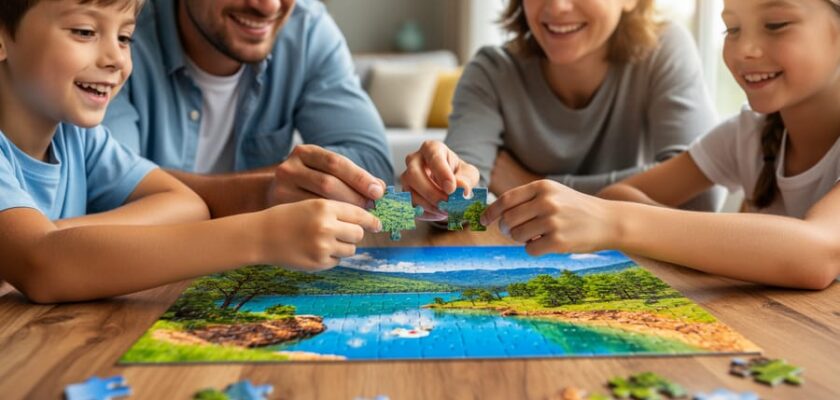
Jigsaw puzzles hold a special kind of magic: they transform scattered pieces into complete pictures while quietly building your brain’s problem-solving power, spatial reasoning skills, and patience. Whether you’re working on a simple five-piece set or tackling a thousand-piece challenge, every puzzle you complete strengthens the same cognitive muscles that help you excel in math, science, and creative thinking.
The magic isn’t just in the finished picture. Each time you pick up a puzzle piece, your brain gets to work analyzing shapes, testing connections, and making predictions. You’re essentially running a mini-science experiment with every attempt. Does this curved edge fit here? What happens when I rotate this piece? Children who regularly solve jigsaw puzzles develop stronger visual-spatial skills, which researchers have linked to success in STEM subjects and everyday tasks like reading maps or building with blocks.
Today’s puzzle world offers something for everyone. You’ll find physical puzzles ranging from beginner-friendly options to intricate 1000-piece sets featuring everything from city skylines to natural wonders. Digital platforms have also made puzzles more accessible, letting families explore countless designs without needing storage space for boxes.
The real enchantment lies in the learning that happens without feeling like work. While your hands move pieces around, your brain practices pattern recognition, develops fine motor skills, and builds the kind of focused concentration that helps in every subject at school. That’s the true magic of jigsaw puzzles: they turn playtime into powerful brain-building time.
What Makes Jigsaw Puzzles Actually Magic?
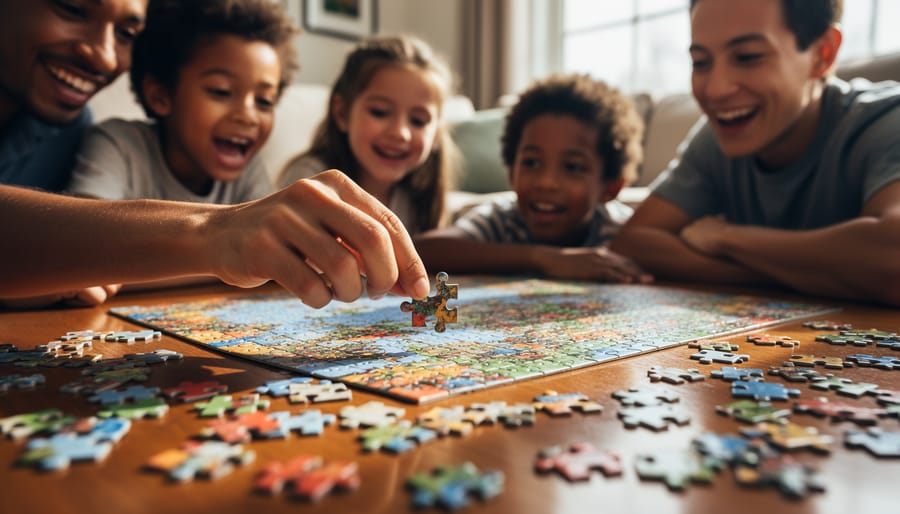
You know that feeling when you dump puzzle pieces onto the table and think, “How will this mess EVER become a picture?” That’s exactly where the magic starts. Jigsaw puzzles are like secret brain trainers disguised as fun, every time you pick up a piece and figure out where it belongs, you’re actually teaching your brain to see patterns, solve problems, and never give up on tricky challenges.
The real magic isn’t about wands or spells. It’s about transformation. Those scattered, confusing pieces hold a hidden picture that only you can unlock. When you start sorting by colors and edges, you’re becoming a detective. When you test pieces that almost fit, you’re learning that mistakes help you discover the right answers. Your brain is working like a super-computer, remembering shapes, comparing colors, and building connections between what you see and where pieces might go.
What seems impossible at first becomes possible, one piece at a time. That beautiful landscape or funny animal picture reveals itself slowly as you work. And then comes the best part, the moment you click that very last piece into place. That’s pure magic! You’ve turned chaos into order, and your brain got stronger doing it.
Whether you’re fitting together five big pieces or five hundred tiny ones, every puzzle trains your brain to see the big picture while handling small details. That’s a superpower you’ll use in math class, art projects, building with blocks, and even planning your day.
The Super Powers Puzzles Give Your Brain
Pattern Detective Skills
Every time you work on a jigsaw puzzle, you’re training your brain to be a pattern detective. Your eyes scan hundreds of pieces, searching for matching edges, similar colors, or repeating designs. This detective work builds crucial visual discrimination skills, the ability to notice tiny differences between shapes and colors that look almost the same.
These pattern recognition abilities connect directly to school success. When you practice spotting which puzzle pieces share the same shade of blue or have curved versus straight edges, you’re strengthening the same brain pathways needed for reading letters (is that a ‘d’ or a ‘b’?) and solving math problems (what comes next in this sequence?). Activities like color matching games build similar skills in a different format.
Here’s the really cool part: pattern detection also powers coding and computer programming. Programmers constantly look for patterns in data and instructions, just like you look for patterns in puzzle pieces. Every time you group pieces by color or identify which pieces belong to the sky versus the ground, you’re practicing logical categorization, a fundamental programming skill that helps organize information into useful groups.
Problem-Solving Like a Pro
Every time you tackle a jigsaw puzzle, you’re training your brain to think like a problem-solver. That giant 1000-piece puzzle looks impossible at first, right? But here’s the secret: you don’t solve it all at once. You break it down.
First, you might sort pieces by color or find all the edge pieces. Then you work on smaller sections, like the blue sky or the red barn. Each little victory brings you closer to the big picture. This exact process, breaking huge challenges into manageable chunks, is how engineers design bridges, how scientists plan experiments, and how programmers write code.
Puzzles also teach you to try different strategies. When a piece doesn’t fit, you don’t give up. You rotate it, set it aside, or look for a different spot. You learn that mistakes aren’t failures; they’re clues pointing you toward the right answer. That kind of flexible thinking helps you tackle tough math problems, science projects, and real-life challenges.
Best of all, puzzles prove that patience pays off. Stick with the tricky parts, and eventually you’ll snap that final piece into place.
Memory Booster Power
Every time you work on a puzzle, your brain turns into a memory booster machine. Think about it: you’re constantly remembering which pieces have curved edges, which ones are mostly blue sky, and where you spotted that weird squiggly shape five minutes ago. Your brain stores all these little details in its working memory, kind of like keeping multiple browser tabs open at once.
The cool part? This memory workout doesn’t stop when you finish the puzzle. Scientists have found that kids who regularly do puzzles get better at remembering instructions at school, keeping track of multi-step math problems, and even recalling stories they’ve read. Your brain is actually building stronger memory pathways each time you think, “Wait, didn’t I see a piece that would fit here?”
The best part is you’re training your memory without even realizing it, because you’re too busy having fun creating a cool picture.
Focus and Patience Training
Every time you sit down with a puzzle, something cool happens: time slows down. You stop checking every two seconds if your friend texted back. You forget about that tricky math homework waiting upstairs. Your brain locks onto one job, finding where that oddly-shaped blue piece belongs, and suddenly twenty minutes vanish like magic.
That’s concentration training disguised as fun. Unlike video games that flash and beep to grab your attention, puzzles make you choose to focus. There’s no timer rushing you, no “Game Over” screen punishing mistakes. You learn to sit with a challenge, trying one approach, then another, until something clicks. This teaches your brain a superpower that helps everywhere: the ability to stick with hard things without giving up.
Patience grows naturally too. That corner section that looked impossible? After checking twelve pieces that didn’t fit, number thirteen slides perfectly into place. You learn that effort pays off, that problems get solved one small step at a time. These aren’t lessons anyone lectures you about, they’re rewards you discover yourself, piece by piece.
Choosing the Perfect Puzzle for Your Age and Skills
Picking the right puzzle is like choosing the perfect STEM challenge, too easy gets boring fast, but too hard might feel frustrating. The sweet spot? A puzzle that stretches your brain just enough to feel like an accomplishment when you finish.
For the youngest puzzlers, simple is magical. Products like “Grow-a-Puzzle: Becoming a Flower” offer just five chunky pieces perfect for babies and toddlers learning to match shapes and colors. These teach foundational spatial reasoning, understanding how objects fit together in space, which is actually early geometry! Toddlers who master these simple puzzles are practicing the same thinking skills they’ll need later for math problems and building block challenges.
| Age Range | Piece Count | Skills Developed |
|---|---|---|
| 1-3 years | 3-10 pieces | Shape recognition, hand-eye coordination |
| 4-6 years | 12-50 pieces | Pattern matching, problem-solving basics |
| 7-9 years | 50-250 pieces | Strategic thinking, spatial reasoning |
| 10-12 years | 250-1000+ pieces | Advanced problem-solving, persistence |
As kids grow, their brains crave more complexity. Elementary schoolers often enjoy puzzles with 50-100 pieces featuring their favorite characters or animals. These mid-range puzzles introduce strategy, should you start with edge pieces or sort by color first? That’s computational thinking in action.
Older kids ready for serious brain workouts can tackle intricate 500- or even 1000-piece challenges. These complex puzzles teach mathematical concepts like estimation (guessing how many sky pieces you need), sorting algorithms (organizing by attributes), and persistence through multi-step problems.
Here’s a parent secret: let kids choose puzzles slightly above their comfort level occasionally. That productive struggle builds resilience and confidence. If your seven-year-old wants to try a 100-piece puzzle instead of their usual 50, celebrate that growth mindset! You can always work together if they need support.
Digital platforms offer built-in difficulty scaling, automatically adjusting piece counts so every session feels just right. Physical puzzles, though, bring that satisfying tactile feedback when pieces click together, both types develop those crucial spatial reasoning skills that make geometry and engineering concepts easier down the road.
Digital Puzzles vs. Physical Puzzles: The Best of Both Worlds
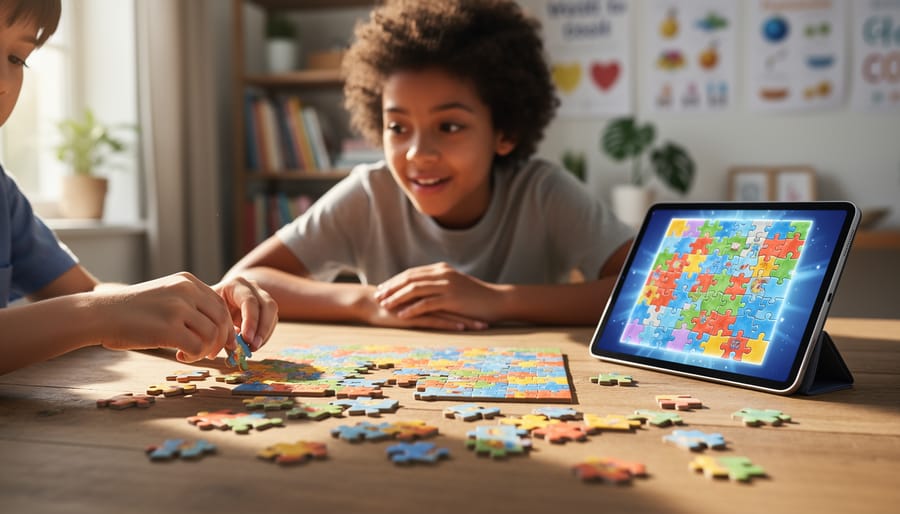
Here’s the truth about puzzles: you don’t have to pick just one type! Digital puzzle apps and physical cardboard puzzles each bring their own special magic to your brain training.
When you tap and drag pieces on a tablet using apps like Magic Jigsaw Puzzles, you get amazing advantages. You can try hundreds of different puzzles without needing shelf space to store them. If you’re traveling in a car or waiting at the doctor’s office, your entire puzzle collection comes with you. Digital puzzles also let you choose exactly the difficulty you want right now, feeling confident? Try a 500-piece challenge. Need something relaxing? Switch to 50 pieces with a single tap.
Physical puzzles, those satisfying cardboard pieces you can hold in your hands, develop different but equally important skills. Your fingers learn precision as you carefully rotate pieces to test if they fit. You build spatial awareness by seeing the whole puzzle spread out in front of you, not just on a screen. The tactile experience of feeling edge pieces versus middle pieces helps younger puzzlers (even toddlers working on simple 5-piece puzzles) develop fine motor control that strengthens their hand muscles for writing and other tasks.
Think of it like having both crayons and markers in your art box. Each tool does something special. Digital puzzles are perfect when you want variety, portability, or instant access to new images. Physical puzzles excel for hands-on learning, family puzzle nights around the table, and building that satisfying stack of completed challenges.
The real magic happens when you enjoy both. Your brain gets the best workout from mixing up your puzzle experiences.
Make Puzzle Time Even More Magical
Want to supercharge puzzle time? These simple ideas transform ordinary puzzles into extraordinary learning adventures that stick with kids long after the last piece clicks into place.
- Launch a family puzzle championship where everyone tackles the same puzzle and tracks completion times. Kids love beating their personal records, and friendly competition builds motivation while teaching goal-setting.
- Create a puzzle achievement gallery by photographing completed masterpieces before breaking them down. Print these photos for a bedroom wall display that celebrates perseverance and growing skills.
- Turn puzzle sessions into calm-down corners after homework or busy days. The focused, repetitive nature of matching pieces naturally soothes anxious minds and helps kids transition between activities.
- Build puzzles collaboratively during designated STEM family nights, where parents and kids work side-by-side. Talk through strategies together: sorting edge pieces, grouping by color, tackling challenging sections as a team.
- Mix puzzles with other types of educational games to create themed learning stations. Pair geography puzzles with atlas exploration, or animal puzzles with nature documentaries.
Try rotating between digital platforms like Magic Jigsaw Puzzles and physical sets. Digital puzzles work brilliantly for car rides or quiet restaurant waits, while cardboard puzzles develop hands-on spatial skills. Each format exercises different learning muscles.
Set up a puzzle swap system with neighbors or classmates. Once kids master a 100-piece puzzle, trading with friends brings fresh challenges without constant purchasing. This teaches resourcefulness while building anticipation for new pictures and difficulty levels.
So here’s the real secret about jigsaw puzzles: they’re one of the sneakiest learning tools ever invented. Every time you connect two pieces, your brain is building new pathways, strengthening its detective skills, and becoming better at solving all kinds of problems. That’s the true magic, and it happens whether you’re tapping pieces on a screen with Magic Jigsaw Puzzles or spreading cardboard pieces across your kitchen table.
The best part? You get to choose your own puzzle adventure. Try digital puzzles when you’re on a long car ride, then grab a physical puzzle for family game night. Mix it up with other brain-boosting puzzles throughout your week. Each puzzle you complete proves something important: challenges that seem impossible at first become totally doable when you break them down and keep going.
Ready to make your brain stronger? Pick any puzzle that looks fun to you and start connecting those pieces. Your super-powered puzzle brain is waiting to amaze you.

