
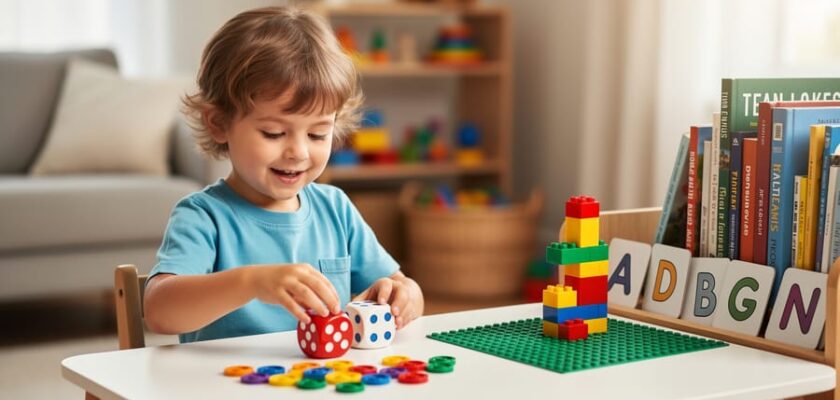
The best homeschooling approach for five-year-olds turns learning into play through hands-on activities that naturally build kindergarten skills. Your child doesn’t need workbooks or formal lessons right now. They need to roll dice while counting spots, build LEGO towers while exploring patterns, and hunt for letters hidden around the house. These gameschooling ideas teach reading, math, and problem-solving without a single worksheet.
If you’re worried that play-based learning isn’t “real” education, here’s what matters: five-year-olds learn best through movement, exploration, and games that feel like pure fun. When your kindergartner sorts toy dinosaurs by size, they’re building math skills. When they act out a favorite story with puppets, they’re developing literacy. The magic happens when children don’t realize they’re learning because they’re too busy having fun.
This guide walks you through eight specific activities you can start today using materials you already own. No expensive curricula required. No complicated prep work. Just simple, engaging games that cover literacy, math, early STEM concepts, and critical thinking. Each activity includes clear learning goals so you’ll know exactly which skills your child is developing, plus practical tips to make implementation smooth.
Whether this is your first year homeschooling or you’re looking to refresh your kindergarten approach, these ideas prove that the best education for young children looks a lot like play.
How We Chose These Gameschooling Activities
We selected these eight activities using strict criteria to ensure they work brilliantly for five-year-olds in real homeschool settings. Every activity needed to tick several boxes before making our list.
First, each must be genuinely age-appropriate. Five-year-olds have specific capabilities and attention spans. These activities match where they are developmentally, not where we wish they were or where they’ll be next year.
Second, they support concrete developmental milestones. We focused on fine motor skills (the hand control needed for future writing), early literacy (letter recognition and phonics foundations), math readiness (counting, sorting, pattern recognition), and problem-solving abilities. Some activities even introduce concepts like spatial reasoning that connect to later work with geometry tools.
Third, we insisted on minimal prep and accessible materials. You shouldn’t need a shopping trip or an hour of setup. Most use items you already own: blocks, cards, dice, paper, crayons.
Finally, the fun factor was non-negotiable. If it felt like a worksheet disguised as a game, we cut it. These activities genuinely delight kids while sneaking in solid learning.
1. Letter Hunt Scavenger Game
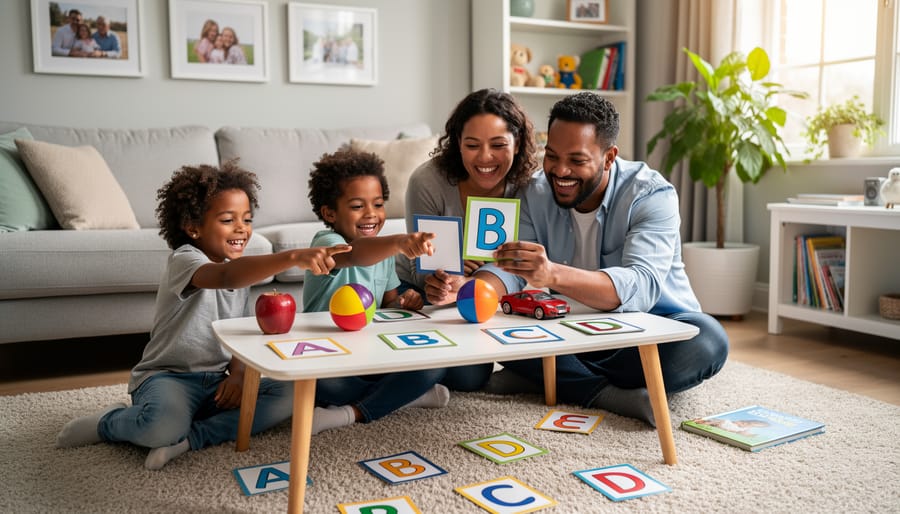
Turn your home into a letter-hunting adventure where your five-year-old becomes a detective searching for alphabet treasures. The setup couldn’t be simpler: write letters on index cards or print a basic alphabet chart, then challenge your child to find objects starting with each letter.
Start with three to five letters per session, don’t overwhelm them with the whole alphabet at once. Hand them a card with “B” and watch them race to find their ball, book, or banana. You can make this as easy or challenging as needed: younger hunters might need you to point them toward areas where objects live (“Check the toy box!”), while confident letter-recognizers can work independently.
The beauty of this game lies in movement and discovery. Kids aren’t sitting at a table drilling letters, they’re running, climbing, and genuinely excited when they spot that elusive “Q” item (a quilt! a quarter!). Take photos of their finds to create a personal alphabet book later.
Mix up the challenge by hunting for specific sounds instead of just first letters (“Find something with ‘ch’ in it”). Hide small toys around one room and give letter clues. Or go outside where leaves become “L,” sticks transform into “S,” and rocks represent “R.”
This game naturally reinforces letter shapes, connects sounds to real objects, and builds that crucial understanding that letters represent actual things in their world.
2. Pattern Block Puzzles & Challenges
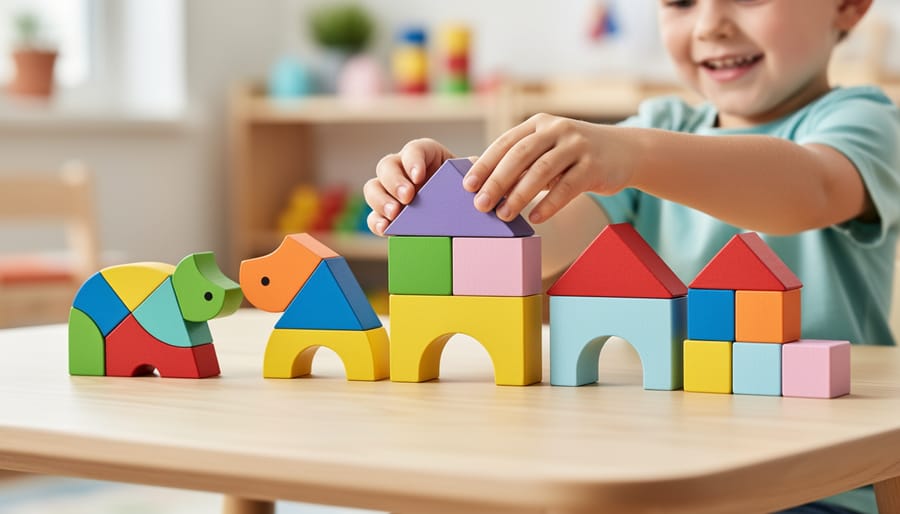
Pattern blocks transform geometry into a hands-on adventure that 5-year-olds can touch, flip, and arrange. These colorful wooden or foam shapes, typically triangles, squares, hexagons, rhombuses, and trapezoids, become building blocks for everything from simple patterns to elaborate robot designs.
Start with pattern cards that show an outline or colored template. Your child places blocks directly on top to match the design, building visual matching skills and shape recognition. As confidence grows, move the card beside the workspace so they recreate patterns from memory rather than covering them. This small shift dramatically increases the spatial reasoning challenge.
Symmetry activities work beautifully with pattern blocks. Create half a design down a center line, then challenge your child to mirror it on the other side. A butterfly with matching wings or a balanced tower teaches mathematical concepts through play without ever mentioning the word “symmetry.”
Freeform creation time matters just as much. When children build their own pictures, a house, a flower, their favorite animal, they’re problem-solving which shapes fit together and how to represent three-dimensional ideas in two dimensions. This creative exploration strengthens spatial thinking and planning skills.
If you don’t have physical blocks, printable pattern block templates work perfectly well. Print, cut, and laminate shapes on cardstock, or let kids color patterns directly on worksheets. The learning happens either way.
3. Story Dice Adventures
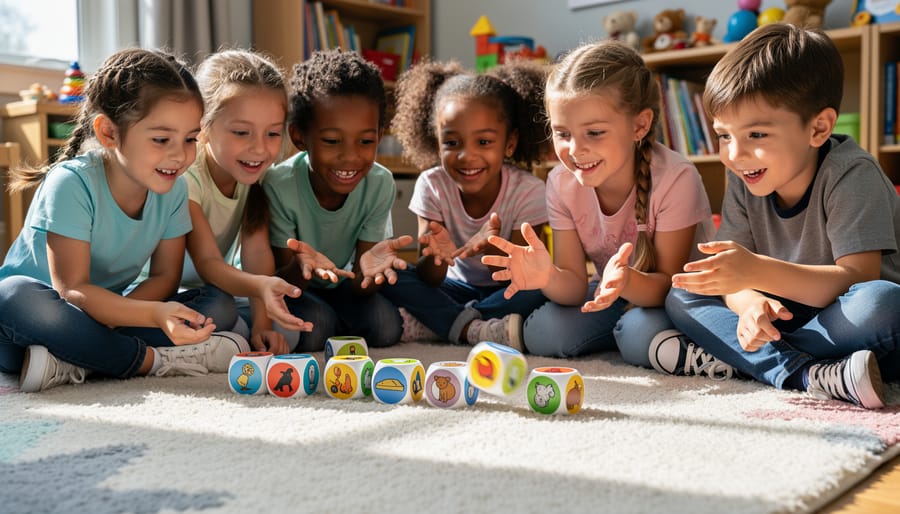
Story dice turn storytelling into an unpredictable adventure that five-year-olds absolutely love. You roll dice covered with simple pictures or words, then weave whatever images appear into a story together. One roll might show a cat, a castle, and a rainbow, suddenly you’re creating a tale about a brave kitten on a quest to find treasure at rainbow’s end.
Making your own story dice is wonderfully simple. Grab wooden blocks or print cube templates, then add six different images to each die. Start with familiar categories: characters (princess, robot, dinosaur), settings (forest, beach, space), and objects (magic wand, bicycle, cookie). You can draw pictures, use stickers, or print clip art. Three dice give you endless combinations without overwhelming young storytellers.
The game works beautifully as collaborative play. Roll the dice together, then take turns adding sentences to build the story. “Once upon a time, there was a friendly dragon…” your child begins. You add the next part, they continue, and the narrative unfolds organically. This back-and-forth naturally teaches story structure, beginning, middle, end, without feeling like a lesson.
Five-year-olds develop crucial skills through this playful activity. They practice sequencing events logically, expand vocabulary as they describe scenes, and learn how stories flow. The randomness keeps it fresh; unlike the same book read repeatedly, story dice create something new every single time.
Similar to how some math learning tips emphasize hands-on discovery, story dice let children construct understanding through doing rather than drilling.
4. Number Garden Counting Game
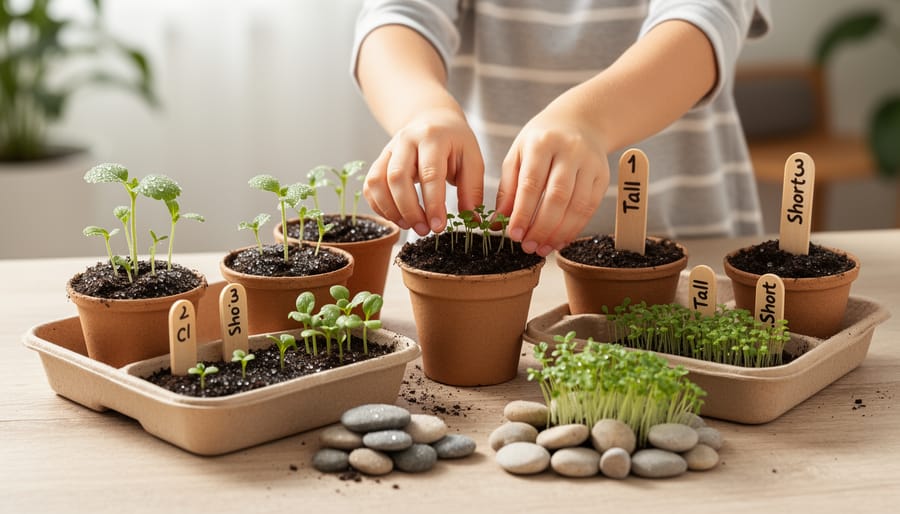
Turn your kitchen table or backyard into a counting garden where math skills bloom naturally through planting, harvesting, and sorting activities.
Set up a pretend garden using egg cartons as seed trays, muffin tins as planting beds, or small pots filled with soil. Give your five-year-old pom-poms, dried beans, or actual seeds to plant. Ask them to count out five seeds for each container, or three beans per pot, suddenly they’re practicing one-to-one correspondence without realizing it’s math.
For real garden adventures, let them plant fast-growing seeds like radishes or sunflowers. They’ll measure plant height with rulers or string, comparing which sprout grew taller. Track growth on a simple chart where they draw or mark measurements weekly.
The harvest phase brings even more learning. Create collection baskets labeled with numbers or colors. Your child sorts toy vegetables by size (big carrots, medium carrots, small carrots) or separates red tomatoes from green ones. Then combine baskets for simple addition, three cucumbers in this basket plus two in that basket equals five total.
If you prefer a no-mess version, print vegetable cards or use foam garden pieces. Children arrange them in rows, count the total crop, or play shopkeeper by bundling vegetables into groups.
The garden theme makes abstract counting concepts concrete. When they physically place each seed, they connect the number word to the actual quantity. That hands-on experience builds number sense far better than worksheets ever could.
5. Coding Unplugged with Treasure Maps
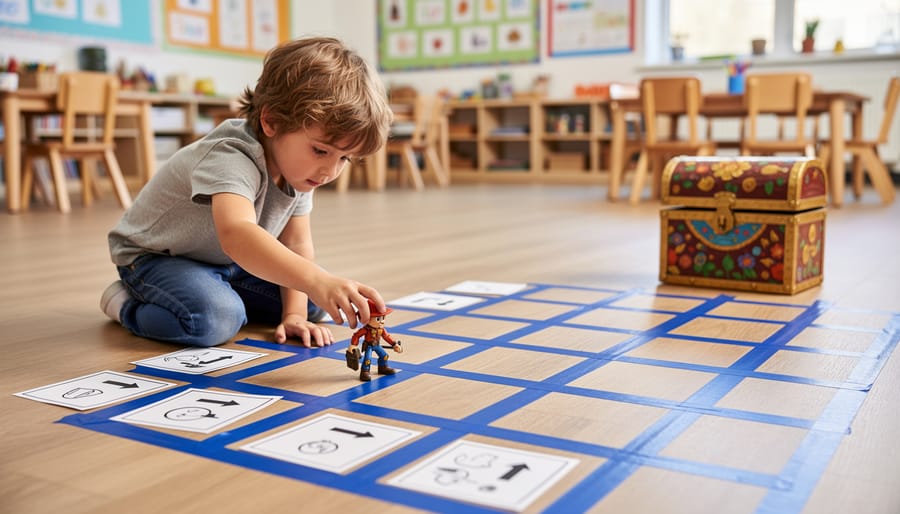
Turn your living room into a coding classroom without touching a single screen. Treasure map games introduce five-year-olds to programming concepts through physical movement and tangible challenges they can see and touch. Children become programmers who create step-by-step instructions to guide a toy figure from start to treasure, learning computational thinking through play that feels like pure adventure.
Start with a simple grid mat marked with squares, masking tape on the floor works perfectly, or print a basic grid on paper. Place a small toy figure on one square and a treasure (sticker, toy coin, or gold-wrapped chocolate) on another. Your child plans the route by saying or placing arrow cards for each move: forward one square, turn right, forward two squares. Then they “run the program” by moving the figure according to their instructions. When the figure doesn’t reach the treasure, they debug their code and try again.
This activity naturally teaches sequencing (actions must happen in the right order), directional language (forward, backward, left, right), and problem-solving (figuring out what went wrong and fixing it). Children grasp that computers follow instructions exactly as given, building computational thinking that translates directly to future coding experiences. The same skills that power STEM toys for older kids start here with paper grids and toy dinosaurs.
Introduce simple coding vocabulary during play. Use these terms naturally as you guide the activity:
- Command: a single instruction like “move forward”
- Sequence: the order of commands to reach the goal
- Algorithm: the complete set of steps that solves the problem
- Debug: fixing mistakes when the program doesn’t work
- Repeat: doing the same action multiple times
Level up by creating obstacle squares the figure must avoid, adding multiple treasures to collect in order, or having your child write the commands on cards before executing them. Some children love being the programmers, others prefer being the toy figure who follows the commands, both roles build valuable skills.
6. Memory Match with a Twist
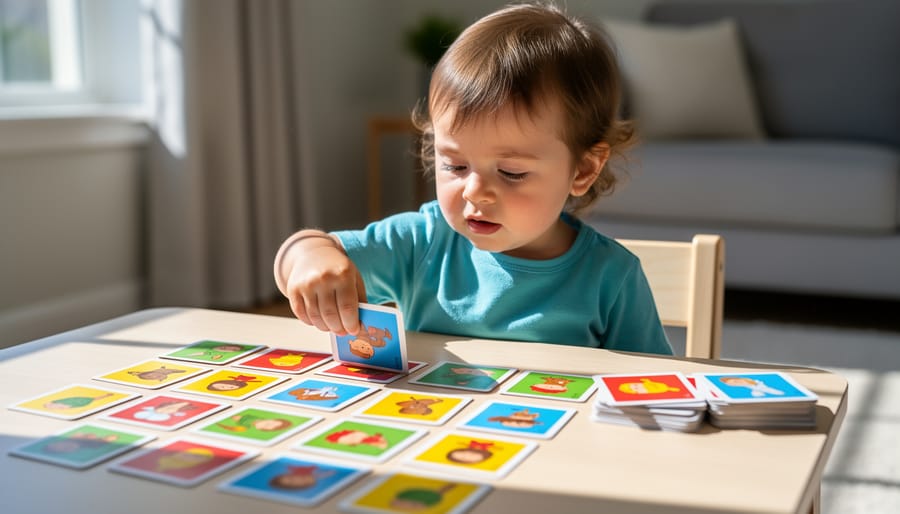
Memory Match gets a homeschool upgrade when you swap plain pictures for learning pairs. The basic flip-two-cards game stays exactly the same, kids love the suspense and challenge, but now they’re building actual skills while they play.
Start with uppercase and lowercase letter matches. Print or draw simple cards showing “A” on one and “a” on another. Your five-year-old flips to find the pairs, getting tons of practice recognizing letters in both forms without realizing they’re doing alphabet work. Once letters feel easy, switch to numbers paired with dot quantities. A card showing “5” matches with five dots arranged like dice patterns or scattered randomly.
Rhyming matches work beautifully too. One card shows a cat, another a hat. Kids flip and listen for the rhyme, which builds phonological awareness, the foundation for reading. Shape name cards (“circle”) pair with actual circle pictures for geometry practice that feels like a game.
Make your own sets with index cards and markers, or print free templates online and laminate them for durability. Start with just six pairs so games stay quick and satisfying. As your child masters a set, add more pairs or mix two themes together for an extra challenge.
The memory aspect strengthens concentration naturally. Five-year-olds get better at tracking where cards are, planning their moves, and managing disappointment when they don’t find a match, all while absorbing letters, numbers, rhymes, and shapes through pure repetition disguised as fun.
7. Building Challenge Cards
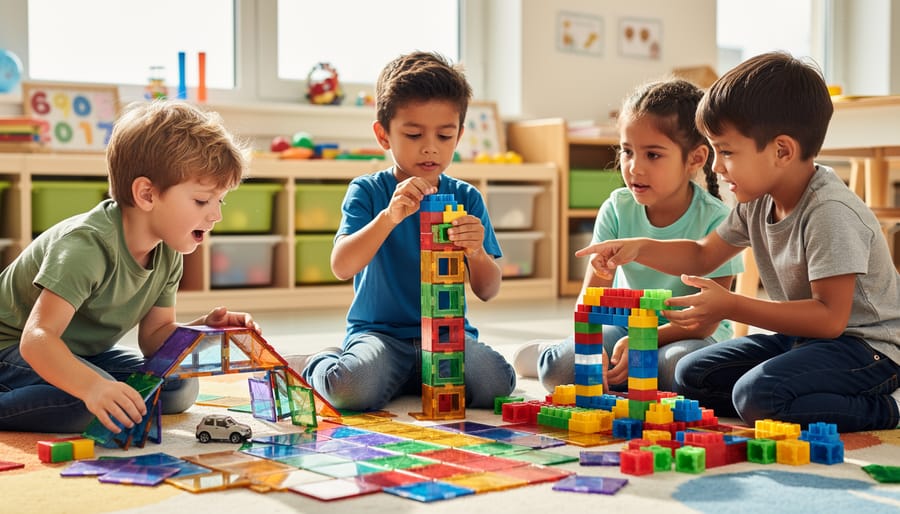
Building Challenge Cards turn any pile of blocks into an engineering adventure. Print simple prompt cards or write challenges on index cards: “Build a bridge that spans between two chairs,” “Create a tower taller than your shoe,” “Make something with wheels that can roll across the floor.” Your 5-year-old draws a card and gets building.
The magic happens when children figure out how to meet each challenge. A bridge needs support underneath. A tall tower requires a wide base or it topples. Something that rolls might need cylinder shapes or actual wheels from toy cars. They’re discovering physics and engineering principles through trial and error, the same way real engineers work.
Start with easier challenges using whatever building materials you have: wooden blocks, LEGO bricks, magnetic tiles, cardboard boxes, or plastic cups. As your child masters basic builds, increase complexity: “Build a house with a door that opens,” “Create a ramp for a marble to roll down,” or “Make a structure using only triangles.” These challenges naturally introduce measurement concepts, taller than, longer than, as wide as, that complement what they might explore through online math tools or hands-on counting games.
The real learning lies in problem-solving and persistence. When a tower crashes, children rebuild with adjustments. When a bridge sags, they add reinforcement. This cycle of building, testing, and improving teaches resilience and critical thinking, skills that extend far beyond block play.
8. Rhyme Time Bingo
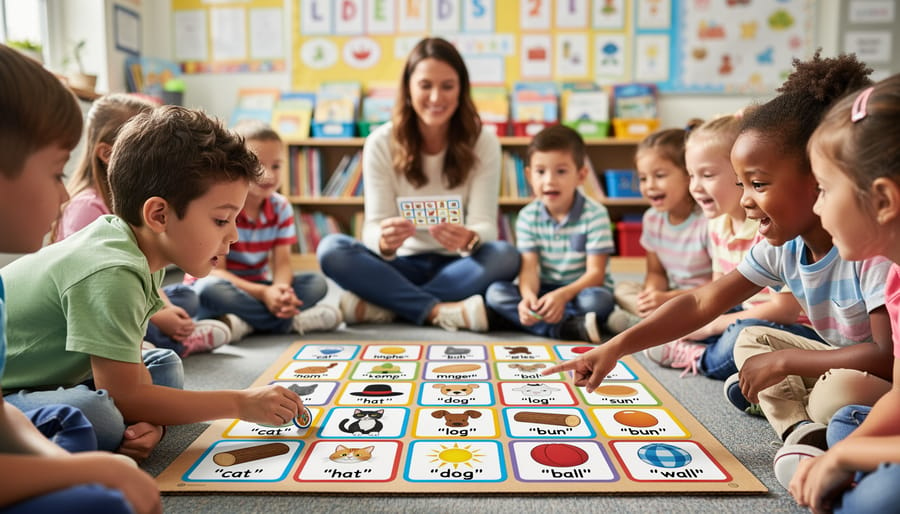
Rhyme Time Bingo transforms the classic game into a powerful phonics tool that 5-year-olds absolutely love. Instead of matching numbers, children listen for rhyming sounds and mark pictures on their cards, turning sound recognition into an exciting competition.
Create bingo cards with simple pictures: cat, hat, tree, bee, frog, dog, cake, snake. When you call out “boat,” your child searches their card for something that rhymes, maybe they’ll find “goat” or “coat.” The twist keeps them actively listening and thinking about word sounds rather than passively waiting for exact matches.
Start with obvious rhymes using short vowel words. As your child gets comfortable, introduce trickier pairs like “bear” and “chair” or “moon” and “spoon.” You can make multiple card versions so siblings or friends can play together, each searching their unique arrangement of pictures.
The beauty of this game is how it sneaks in critical pre-reading practice. Before children can sound out written words, they need to hear that “cat” and “hat” share the same ending sound. This phonological awareness, recognizing and manipulating sounds in words, is one of the strongest predictors of reading success.
Keep rounds short and celebrate enthusiastically when someone gets bingo. You can play with small prizes (stickers work wonders) or simply the joy of winning. Many children request this game repeatedly, which means they’re choosing to practice essential literacy skills disguised as pure fun.
Quick Tips for Successful Gameschooling
Keep your gameschooling sessions short and sweet. Twenty minutes of engaged play beats an hour of forced learning every time. Five-year-olds have naturally short attention spans, so stopping while they’re still interested means they’ll come back eager for more tomorrow.
Follow your child’s lead whenever possible. If they want to hunt for the letter M but you’d planned N, go with M. When they decide the pattern blocks should become a spaceship instead of following your design card, that’s creative thinking in action. The learning happens either way.
Rotate activities before they get stale. Pull out the story dice for a few days, then switch to treasure maps while the dice take a break. This keeps everything feeling fresh and lets you cycle back to favorites with renewed enthusiasm.
Celebrate attempts, not just correct answers. Your five-year-old counted seven items when there were actually eight? That’s fantastic counting practice. They built a bridge that collapsed? Perfect, now they understand why engineers test designs. The goal is building confidence and curiosity, not perfection.
Some days will be more playful than others, and that’s completely fine. If your child just wants to free-build with blocks instead of following challenge cards, they’re still developing spatial reasoning and creativity. Trust that play itself is powerful learning.
Common Questions About Gameschooling 5-Year-Olds
How much time should we spend on gameschooling each day?
Start with 15-20 minute sessions, one to three times daily, matching your 5-year-old’s attention span. Quality matters far more than quantity, three engaged sessions of focused play teach more than an hour of restless seat time.
What if my child only wants to play and resists learning activities?
That resistance often means the activity feels too much like work. Let your child lead the game, reduce direct instruction, and focus on playful exploration, the learning happens naturally when they’re genuinely engaged.
Do I need expensive games and materials?
Not at all. Most effective gameschooling uses simple materials you already have, paper, blocks, household items, outdoor spaces. The magic comes from your involvement and creativity, not fancy products.
How do I know if my child is actually learning?
Watch for increasing complexity in their play, new vocabulary appearing in conversations, and growing confidence with skills like counting or letter recognition. Learning at this age shows up in play patterns and everyday moments, not formal assessments.
These questions reflect what most parents wonder when they begin gameschooling, especially if they’re coming from traditional education models. The tension between “just playing” and “real learning” feels particularly sharp for parents of kindergarten-age children who worry about falling behind peers in conventional schools.
Trust that your 5-year-old’s brain is wired for learning through play. When a child builds with blocks, they’re exploring physics, spatial relationships, and problem-solving. When they create silly rhymes during car rides, they’re developing phonological awareness critical for reading. The learning is happening, even when it looks like pure fun.
Some days your child will dive deep into pattern blocks for 45 minutes. Other days you’ll get five minutes of letter hunts before they’re off to build fairy houses. Both days count. Gameschooling meets kindergarten standards not by forcing academic content into resistant minds, but by creating conditions where children naturally develop the skills those standards describe, curiosity, persistence, pattern recognition, communication, and creative thinking.
Gameschooling turns learning into an adventure your 5-year-old will ask to repeat tomorrow. These eight activities prove that building skills and having fun aren’t opposites. They’re the same thing when you approach homeschooling through play.
You don’t need to implement everything at once. Pick one activity that matches your child’s current interests. Maybe they’re fascinated by letters right now, so start with the Letter Hunt. If they love building, jump straight to the challenge cards. Watch what lights them up, then follow that spark.
Some days your child will race through three activities and beg for more. Other days, you’ll get ten minutes before they wander off to something else. Both outcomes are completely normal and equally valuable. Learning happens in those brief, focused moments just as much as during longer sessions.
Trust the process. When your 5-year-old rolls story dice and creates wild tales, they’re developing narrative skills. When they build block towers, they’re exploring physics and measurement. Play is their most effective learning tool right now.
Ready for more hands-on learning adventures? Explore our collection of STEM activities and creative play ideas designed specifically for young learners who learn best through discovery and fun.
