
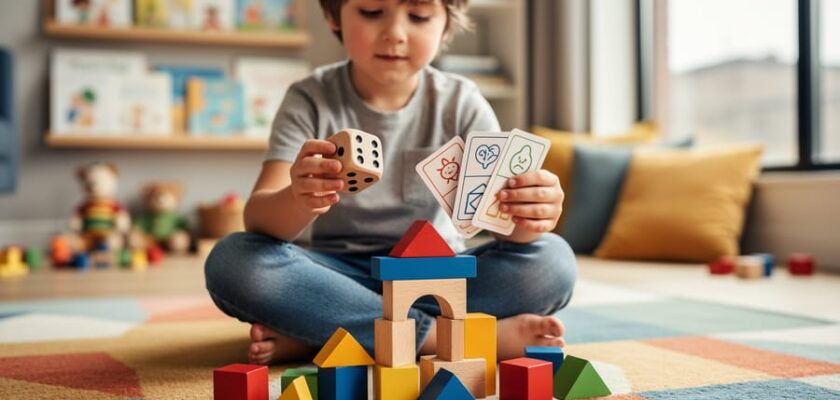
Gameschooling transforms kindergarten homeschooling into an adventure where play and learning merge so seamlessly that your five-year-old won’t realize they’re mastering essential skills. Instead of worksheets and rigid schedules, you’ll use board games, active play, and hands-on challenges to teach reading, math, science, and critical thinking. The approach works because kindergartners learn best through movement, exploration, and repetition disguised as fun.
Your kindergartner is wired for play. Their brain forms connections fastest when they’re physically active, emotionally invested, and solving problems that feel meaningful. A dice game that practices counting delivers better retention than flashcards. A treasure hunt that requires reading simple words beats drill-and-practice worksheets every time.
The beauty of gameschooling at this age is flexibility. Some days your kindergartner might spend an hour building with blocks, learning spatial reasoning and early engineering concepts. Other days, a 15-minute card game covers pattern recognition and turn-taking. You’re not locked into a curriculum that moves too fast or too slow.
The ten activities ahead give you a complete toolkit for covering kindergarten standards through games. Each one targets specific skills while keeping the experience joyful. You’ll find options for active learners who need to move, quiet activities for focused work, and group games that build social skills. Most require materials you already own, and all can be adapted as your child grows. Let’s jump into the games that will make this kindergarten year both effective and unforgettable.
Why Gameschooling Works for Kindergarteners
Kindergarteners learn best through play, and gameschooling taps directly into that natural drive. At ages five and six, children are wired for exploration, repetition, and discovery, all things games deliver naturally. A meta-analysis of game-based learning shows that game formats boost both engagement and knowledge retention compared to traditional instruction, particularly for young learners.
Game-based learning aligns perfectly with play-based kindergarten goals while keeping kids motivated. When your kindergartener races to match letter sounds or builds towers in a STEM challenge, they’re practicing core skills without the resistance that worksheets often trigger. The game structure provides natural repetition, immediate feedback, and a safe space to make mistakes and try again.
Here’s what makes gameschooling especially effective for this age:
- Children stay engaged longer because games feel like fun, not work
- Turn-taking and rule-following build social and executive function skills
- Hands-on play reinforces concepts better than passive listening
- Competition with themselves (not just others) builds confidence and persistence
- Games naturally integrate multiple skills at once, counting, reading, strategizing
Whether you’re using board games, outdoor scavenger hunts, or online math tools the play-based approach keeps kindergarteners excited about learning while covering the same foundational skills traditional methods target.
How We Chose These Activities
We picked these ten gameschooling activities using four simple filters that matter most to homeschool families with kindergarteners.
First, every game had to fit the developmental sweet spot for five- and six-year-olds, challenging enough to build skills but never so complex that you’d lose their attention or confidence. We watched for activities that kindergarteners could grasp quickly and then grow with over time.
Second, we looked for balanced skill coverage. You’ll find games here that teach literacy, math, STEM concepts, and creativity, so you’re not accidentally skipping entire learning domains while you’re having fun together.
Third, we chose activities you can actually set up without a degree in craft engineering or a shopping spree at specialty stores. Most use materials you already own or can grab cheaply. Homeschooling shouldn’t mean hours of prep before the learning even starts.
Finally, we prioritized proven engagement. These aren’t games that sound educational on paper but bore kids in real life, they’re activities that kindergarteners genuinely ask to play again, which means you’re building skills through repeated practice disguised as pure fun.
1. Letter Sound Treasure Hunt
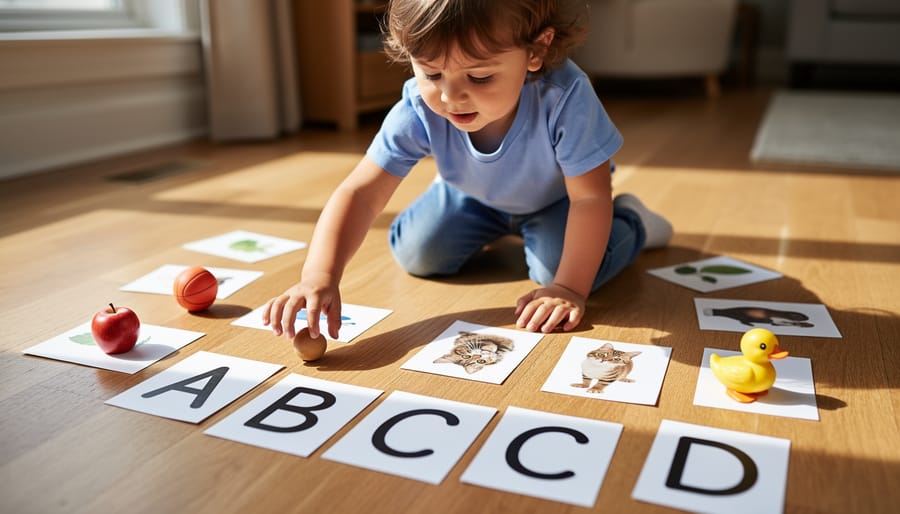
Grab a basket and some alphabet cards, you’re about to turn your living room into a phonics playground. Letter Sound Treasure Hunt gets kindergarteners moving while they master the sounds letters make, which is the foundation for reading.
How it works: Choose 3-5 letter sounds your child is learning (start with common ones like /b/, /s/, /t/, /m/). Write each letter on an index card and show your child the sound it makes. Then send them hunting through the house to find objects that start with each sound, a ball for /b/, a spoon for /s/, a toy truck for /t/. When they bring items back, they place each object on its matching letter card.
Why kindergarteners love it: The combination of movement and discovery keeps them engaged far longer than flashcards ever could. There’s a satisfying “aha!” moment when they connect that the sock they found really does start with the /s/ sound.
Extension ideas: Once they’ve mastered beginning sounds, hide objects for ending sounds or create timed challenges where they race to find all items before a sand timer runs out. You can also do themed hunts, finding only toys, only kitchen items, or only things that are blue.
2. Board Game Math Adventures
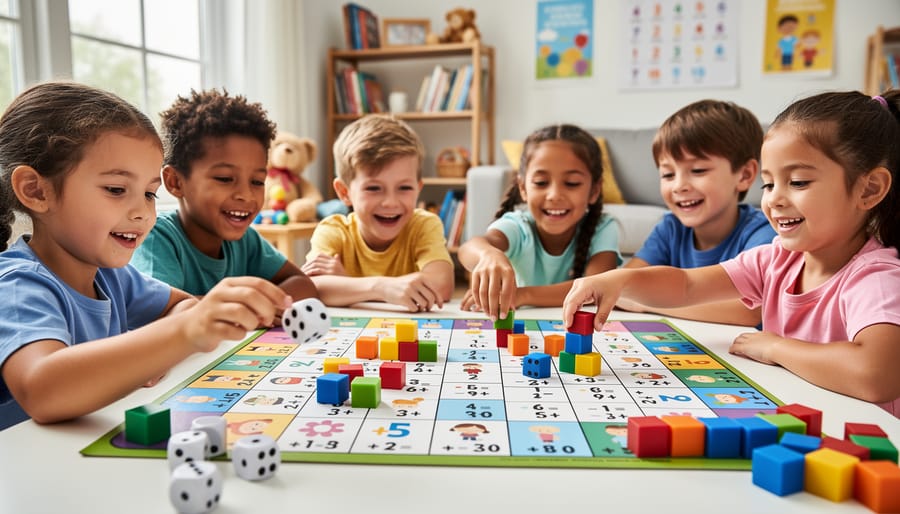
Board games you already own are secret math teachers. Candy Land, Chutes and Ladders, and similar classics turn counting into something kindergarteners beg to practice. Instead of worksheets, your child moves a game piece, counts spaces aloud, and celebrates reaching the finish line, all while building number sense without realizing it’s “school.”
Start simple: have your kindergartener count each space as they move their piece. “One, two, three, four!” This reinforces one-to-one correspondence and number sequencing. As they get comfortable, add small challenges. With two dice, ask them to count the dots on each die separately, then add them together before moving. Don’t worry if they count on their fingers, that’s perfectly normal and builds understanding.
Create custom number cards to replace spinners or dice. Write numbers 1-6 on index cards, shuffle them, and let your child draw one each turn. They’ll practice recognizing numerals while still enjoying the game’s excitement. You can even sneak in simple addition: “You drew a 3, and you’re on space 5. Where will you land?”
The beauty of board game math is the natural repetition. Your kindergartener plays the same game repeatedly, getting dozens of counting practice opportunities in twenty minutes. They’re learning turn-taking and patience too, social skills that matter just as much as math facts. Pair these analog games with age-appropriate STEM toys as they grow, and you’ll build a foundation that makes later math concepts feel like play.
3. STEM Building Challenges
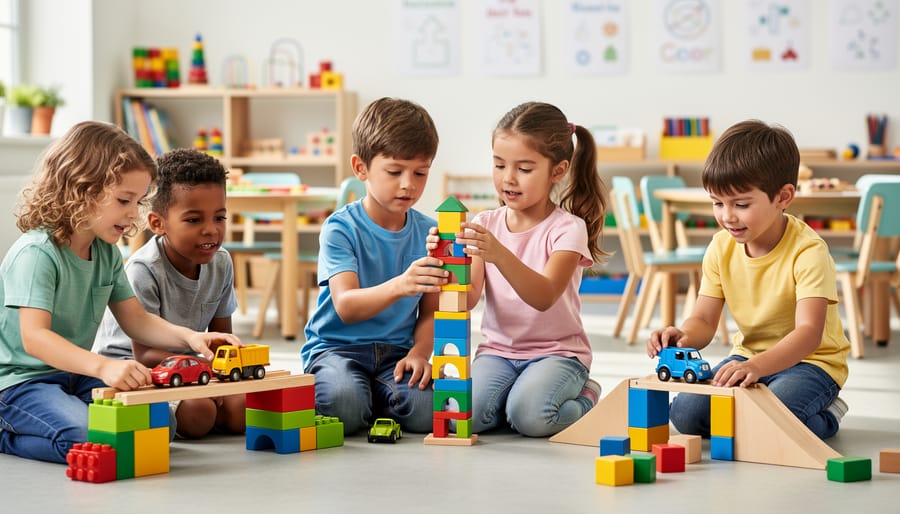
Grab a pile of blocks, LEGO bricks, or even cardboard boxes and toilet paper rolls, you’ve got everything you need for engineering games that make kindergarteners think like builders. STEM building challenges turn construction play into focused learning without losing the fun.
Start with simple competitions: “Can you build a tower taller than your head?” or “Make a bridge strong enough for this toy car to drive across.” The challenge aspect hooks kids instantly. They’ll experiment with balance, test which shapes stack best, and figure out why their tower keeps wobbling. That’s spatial reasoning and problem-solving happening naturally through trial and error.
Mix up your challenges to keep things fresh. Try “build a house for this stuffed animal” (introduces planning), “create the longest road using only ten blocks” (teaches measurement and resource limits), or “design a ramp that makes the ball roll into the cup” (explores angles and gravity). Give them a timer for added excitement, five minutes to build the tallest structure creates just enough friendly pressure to stay engaged.
Let structures fall. Failed attempts teach persistence and redesign, core engineering skills that’ll serve them well beyond kindergarten. Celebrate creative solutions even when they don’t match your adult vision of how things should work.
4. Sight Word Bingo
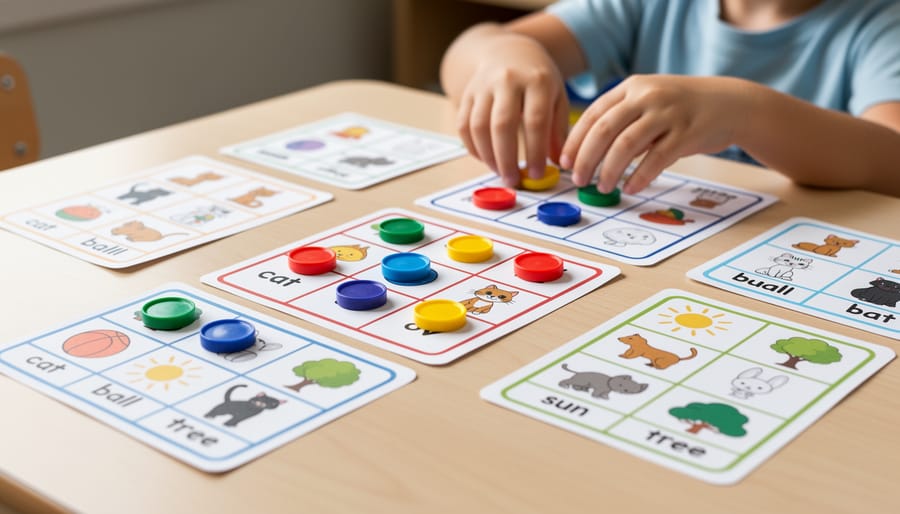
Sight Word Bingo turns essential reading practice into an exciting game your kindergartener will actually ask to play again. Create simple bingo cards (5×5 grids work well) filled with common sight words like “the,” “and,” “can,” “see,” and “my.” You can draw these by hand or print free templates online.
Call out words one at a time while your child searches their card and marks matches with buttons, coins, or small toys. When they find a word, have them say it aloud before marking it, this reinforces both recognition and pronunciation. The first to complete a row, column, or the whole card wins.
Make it more interactive by having your child be the caller sometimes, or race against a timer for added excitement. Start with 10-15 basic words and gradually introduce new ones as confidence builds. You can theme cards around word families (all words with “at” or “an”) or mix in tricky words that need extra practice.
Keep multiple card variations so siblings can play together, each searching different arrangements of the same word list. The friendly competition makes repetition feel fresh instead of tedious.
5. Coding Board Games
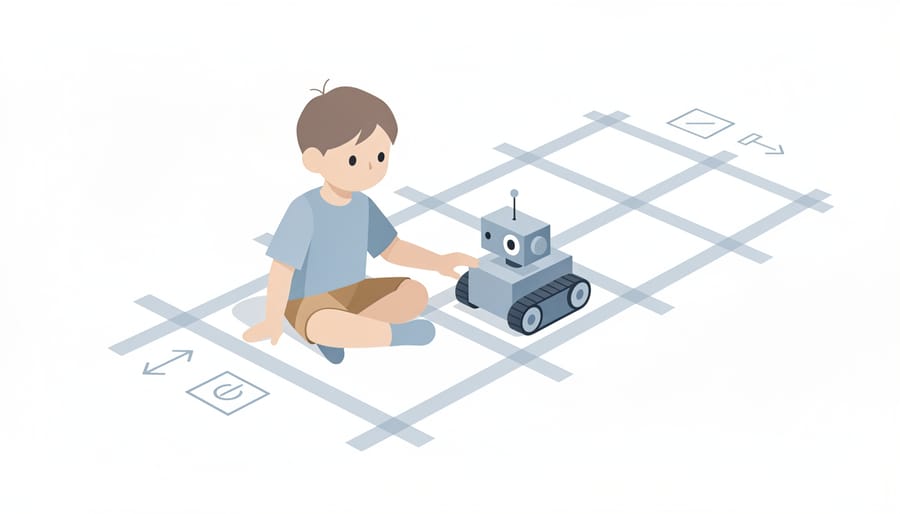
Coding board games bring computer science concepts to your kitchen table without a single screen. Robot Turtles and Code Master Jr. turn programming fundamentals into tactile, playful challenges perfect for kindergarten minds.
These games teach sequencing, the step-by-step thinking that powers all coding. Your child arranges cards to tell a turtle where to move or plans a path through a maze. They learn that order matters, mistakes can be fixed, and complex problems break down into simple steps.
The genius? Children debug naturally. When their turtle doesn’t reach the jewel, they spot the error in their card sequence and try again without frustration. This trial-and-error mindset builds the persistence programmers need.
Code Master Jr. adds logic puzzles where children figure out the right sequence to solve visual challenges. Robot Turtles lets parents act as the “computer” executing commands, which makes abstract concepts concrete and giggly.
Start with five-minute games and let your kindergartener lead the difficulty progression. These unplugged tools lay groundwork for digital coding later while strengthening critical thinking, spatial reasoning, and problem-solving right now.
6. Nature Scavenger Hunt with Sorting
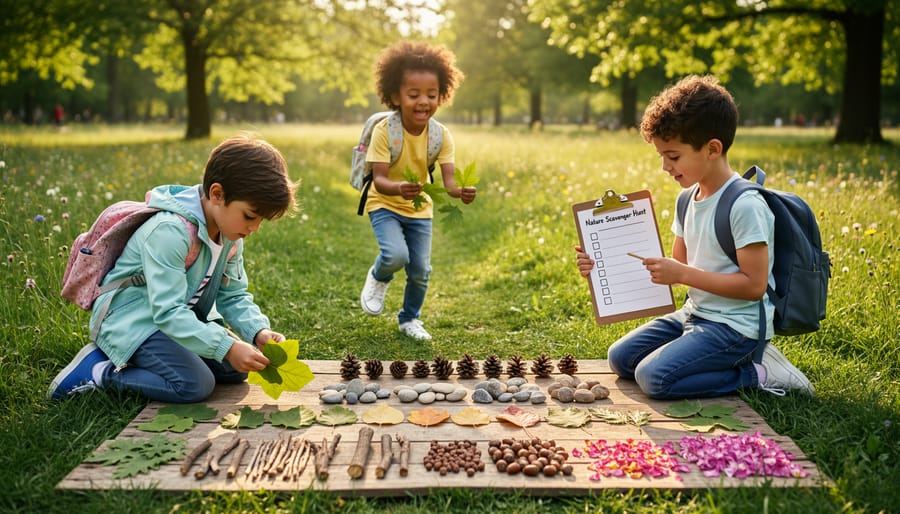
Grab a basket and head outside, this nature scavenger hunt turns your backyard, park, or nature trail into a hands-on science and math classroom. Give your kindergartener a simple list of items to find: something smooth, something rough, a red leaf, a brown stick, three small rocks, or anything that catches their eye. The hunt itself builds observation skills and gets them moving, but the real learning kicks in when you return home and start sorting the collection.
Spread out the treasures on a table or blanket and ask your child to group them in different ways. Sort by color first, all the green leaves together, brown sticks in another pile, gray rocks over here. Then try size: big versus small, or arrange items from smallest to largest. Next, sort by texture (smooth versus bumpy) or type (leaves, rocks, twigs). Each round of sorting reinforces classification skills and early data organization, core concepts that connect to everything from geometry tools to science experiments as they grow.
Make it a game by timing how fast they can re-sort or challenging them to find a new sorting rule you haven’t tried yet. You can even create simple graphs together, stack rocks to show how many of each color you found, turning the collection into a visual math lesson.
7. Story Dice Creative Writing
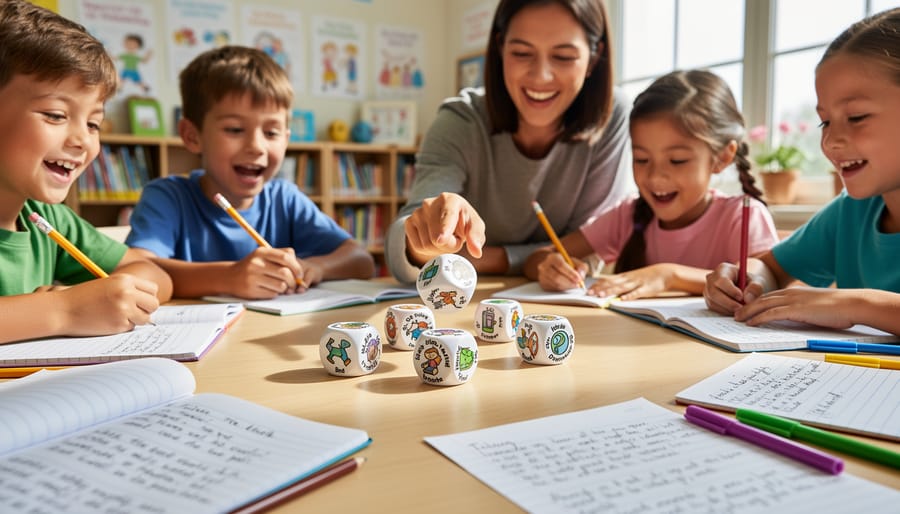
Roll dice with pictures or simple words, then weave them into a story together. This game turns storytelling into an unpredictable adventure that kindergarteners love because they never know what silly combination will appear next.
Start with six-sided dice featuring images, animals, objects, actions, or settings. Your child rolls three dice and you both create a story using what appears. “A dragon ate pizza at the beach” becomes a launching point for wild narratives. Take turns adding sentences, or let your kindergartener dictate while you write their words down.
Make your own story dice using wooden blocks and stickers, or draw pictures on blank dice with permanent markers. For emerging writers, focus on oral storytelling first. As confidence grows, help your child write one sentence about their story, or let them draw the tale in comic-strip panels.
Adapt difficulty by changing what’s on the dice. Use sight words instead of pictures for reading practice, or mix both. Roll just two dice for shorter stories when attention wanes, or add a fourth die for experienced storytellers ready for complexity. The randomness keeps every session fresh and giggles guaranteed.
8. Pattern Block Puzzles and Games
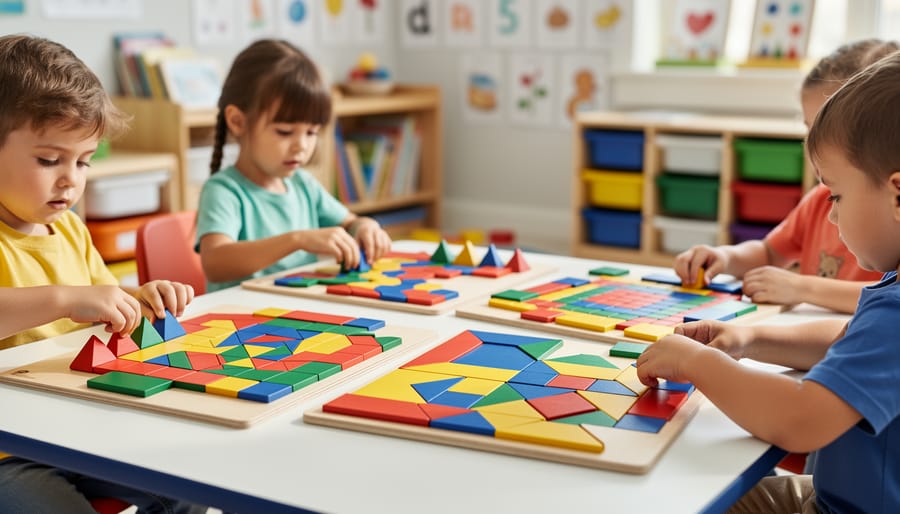
Pattern blocks are geometry superstars disguised as colorful toys. Those wooden or plastic hexagons, trapezoids, triangles, squares, rhombuses, and triangles let kindergarteners explore shapes, symmetry, and spatial relationships through hands-on play. Start with simple challenges: “Can you make a flower using only red and yellow blocks?” or “Build the same pattern I just made.” These puzzles teach shape names, how shapes fit together, and early fraction concepts (two trapezoids make a hexagon) without feeling like math class.
Turn pattern blocks into games to boost engagement. Try “Pattern Block Race” where two children compete to complete the same puzzle card first, or collaborative challenges like building the longest snake using alternating colors. “Guess My Pattern” works brilliantly, one child creates a hidden pattern while the other asks yes/no questions to recreate it, building critical thinking and communication skills. Pattern blocks complement digital tools if you later choose online math resources, offering tactile geometry practice that screens can’t replicate. Rotate between free exploration, guided puzzles, and timed games to keep your kindergartener discovering new spatial possibilities every session.
9. Memory Match with Learning Goals
Memory cards aren’t just for matching identical pictures anymore. Turn this kindergarten classic into a powerhouse learning game by pairing related concepts instead of duplicates. Create cards that match uppercase A to lowercase a, the number 5 to five dots, a triangle card to the word “triangle,” or “cat” to “hat” for rhyming practice. Your kindergartener flips two cards each turn, searching for logical pairs rather than visual twins, which deepens understanding while building memory skills.
The beauty of memory match games is their flexibility. Start with just six pairs when introducing a new concept like letter matching, then add more cards as confidence grows. Mix up the learning goals throughout the week, Monday focuses on number-quantity pairs, Wednesday tackles shape names, Friday practices rhyming words. This rotation keeps the game fresh while systematically covering essential kindergarten skills.
Make your own cards using index cards and markers, or print free templates online. For families exploring digital options alongside hands-on games, our math buying guide reviews interactive tools that complement card-based learning. The tactile experience of flipping physical cards, though, offers sensory engagement that screens can’t replicate, making this game perfect for active kindergarteners who learn best through touch and movement.
10. Kitchen Science Experiments as Games
Your kitchen becomes a science lab when you turn everyday experiments into guessing games. Kindergarteners love making predictions, and each experiment lets them practice the scientific method without realizing they’re doing serious learning.
Start with sink or float. Gather safe objects like a spoon, sponge, apple, toy car, and crayon. Before dropping each item in water, ask “Will it sink or float?” Let your child make a guess, explain their thinking, then test it together. Keep a simple chart with pictures to track results. This builds observation skills and introduces the idea of testing predictions.
Dissolving races work brilliantly too. Fill clear cups with water and let your kindergartener predict which will dissolve faster: salt, sugar, sand, or a small piece of paper. They’ll watch closely, compare what happens, and learn that not everything disappears in water.
Color mixing becomes a game when you challenge them to create specific colors. “Can you make purple? What happens if we add more red?” Use food coloring in water or mix paint colors while they predict the results.
Baking soda volcanoes never get old. Add food coloring to make it more game-like: “Which color lava will we make today?” The fizzy reaction teaches simple chemical reactions through pure excitement.
These experiments take five minutes but teach patience, careful observation, and cause-and-effect thinking while keeping kindergarteners giggling and engaged.
Making Gameschooling Part of Your Daily Routine
You don’t need to overhaul your entire homeschool day to make gameschooling work. Start by replacing just one traditional worksheet or lesson with a game-based activity, maybe a sight word bingo session instead of flashcard drills, or a pattern block challenge before lunch. Kindergarteners thrive on predictable rhythms, so consider anchoring game time to natural transitions: a math board game after breakfast, a building challenge before outdoor play, or story dice at the end of your school block.
Rotate activities every few days rather than cycling through all ten each week. If your child loves the letter sound treasure hunt, let them play it three days running while their enthusiasm peaks, that repetition actually deepens learning. Then swap in a different game when interest wanes. Keep a simple basket or shelf with this week’s chosen games so materials stay accessible and setup takes seconds, not twenty minutes of digging through closets.
Track progress through observation rather than formal testing. Notice when your kindergartener counts game spaces without prompting, recognizes sight words during story dice, or solves building challenges with more sophisticated strategies. Snap quick photos of block creations or jot notes about “aha” moments you witness during play. This documentation captures real learning while keeping the joy intact, and gives you confidence that play truly is powerful teaching.
Common Questions About Gameschooling Kindergarten
Is gameschooling rigorous enough for kindergarten?
Yes. Games teach the same foundational skills as worksheets, counting, letter sounds, problem-solving, but children retain more because they’re engaged and motivated. You’re covering academic standards through play, which actually strengthens learning.
How do I know my child is actually learning?
Watch for skill application during games: counting spaces correctly, recognizing sight words without help, solving pattern challenges independently. These real-time demonstrations show deeper understanding than memorized worksheet answers.
What if my kindergartener only wants to play the same game repeatedly?
That’s normal and beneficial. Repetition builds mastery and confidence. Once they’ve thoroughly explored one game, gently introduce variations or a new activity with similar appeal to maintain interest while expanding skills.
How much time should we spend on game-based learning each day?
Start with 30-45 minutes of intentional gameschooling, broken into two or three short sessions. Kindergarteners have limited attention spans, so multiple brief, playful activities work better than one long session.
Remember that gameschooling doesn’t replace your entire homeschool day. You’ll still read together, practice writing, and do hands-on projects. Games simply make skill-building feel less like “school” and more like what kindergarteners naturally love: playing, exploring, and discovering new things. Trust your observations, if your child can count to twenty during board games, recognizes letters during treasure hunts, and eagerly asks to play learning games, you’re doing it right.
Gameschooling transforms kindergarten from a checklist of skills into an adventure your child actually wants to wake up for. These ten activities prove that learning doesn’t need to feel like work when it’s wrapped in play, discovery, and a bit of friendly competition.
You don’t need to implement everything at once. Pick one or two games that match your child’s current interests, see what sparks joy, and build from there. Some weeks you’ll run letter hunts daily. Other weeks, your kindergartener will beg for STEM building challenges every afternoon. That’s exactly how it should work.
Ready to expand your homeschool toolkit? BlackDog offers hundreds of free resources for STEM learning, coding games, and creative activities designed specifically for young learners. Your kindergartener’s next favorite learning game is waiting.

