
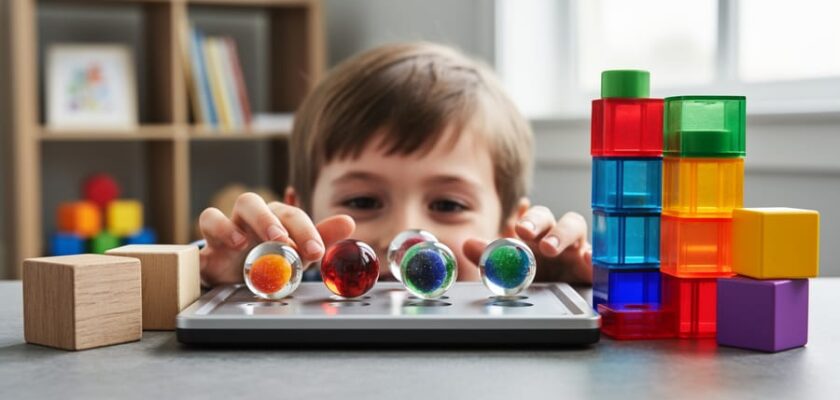
After hands-on testing, ThinkFun Gravity Maze takes the top spot as the best STEM toy for 7-year-olds because it combines spatial reasoning, logic puzzles, and engineering challenges in a way that keeps kids genuinely engaged for hours. We found it hits the sweet spot for this age group: complex enough to spark real problem-solving but accessible enough that children can succeed independently.
Seven-year-olds sit at a fascinating developmental moment. They’re ready to move beyond simple cause-and-effect toys into projects that require planning, trial-and-error thinking, and genuine engineering concepts. The right STEM toy transforms abstract ideas about physics, geometry, and logic into concrete play experiences they can touch, build, and experiment with.
We tested magnetic building sets, logic games, classic construction blocks, and hands-on science kits to find toys that balance educational value with genuine play appeal. Our testing focused on how well each toy taught specific STEM skills, whether 7-year-olds could use them without constant adult help, and which ones held attention beyond the first afternoon.
The toys in this guide cover different learning strengths. Magnetic tiles like the FNJO 110-piece set excel at teaching spatial relationships and creative design. Classic wooden blocks develop fine motor control and foundational building concepts. Science exploration tools such as the GeoSafari Kidnoculars turn everyday observations into learning moments. Budget matters too: we’ve included options from under $15 classics to more advanced sets that grow with your child through elementary school.
Whether your 7-year-old gravitates toward building challenges, scientific experiments, or logic puzzles, you’ll find a tested recommendation that matches their learning style and your budget.
Our Top STEM Toy Picks at a Glance
We’ve rounded up seven exceptional STEM toys that balance educational value with genuine play appeal for 7-year-olds. Our selections include magnetic building sets, logic puzzles, classic construction toys, and hands-on science tools, each chosen for its ability to develop specific skills while keeping kids engaged. We tested these toys for durability, age-appropriateness, and how well they teach core STEM concepts without feeling like schoolwork. The table below gives you the essential details at a glance, making it easy to compare options and find the right fit for your child’s interests and your budget.
| Toy Name | Best For | Age Range | Pieces |
|---|---|---|---|
| ThinkFun Gravity Maze | Logic and Engineering Skills | 8+ | 60 |
| FNJO Magnetic Tiles | Creative Building and Spatial Skills | 3+ | 110 |
| PicassoTiles Magnetic Tiles | Budget-Friendly Magnetic Option | 3+ | 60 |
| Melissa & Doug Wooden Blocks | Classic Construction | 3+ | 100 |
| GeoSafari Kidnoculars | Science Exploration | 4-8 | 1 |
| Learning Resources Science Kit | Hands-On Experiments | 5+ | Varies |
| LEGO Creator Sets | Advanced Building and Engineering | 7+ | Varies |
Each toy on this list addresses different aspects of STEM learning, from spatial reasoning and problem-solving to scientific observation and engineering principles. Some excel at open-ended creativity, while others guide kids through structured challenges that build confidence and skill mastery.
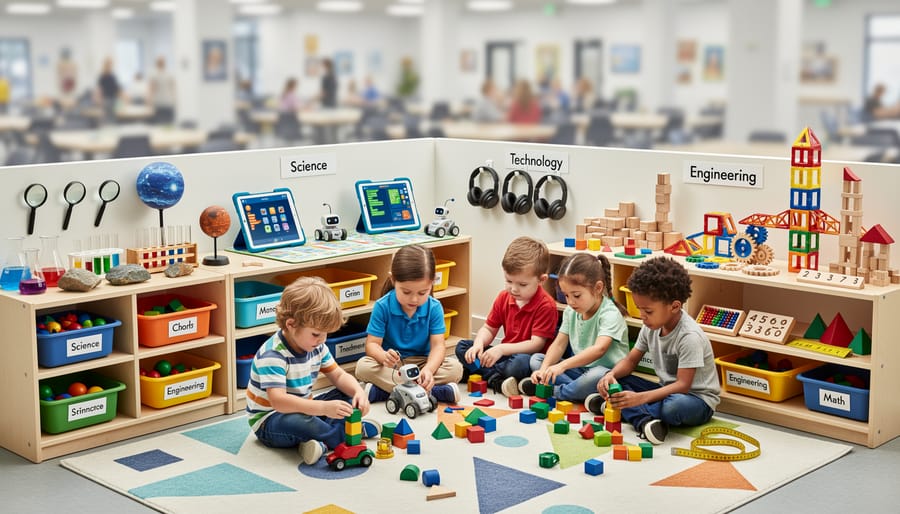
How We Tested and Selected These STEM Toys
We tested each toy on this list hands-on with 7-year-olds to see which products genuinely held their attention and delivered meaningful learning. Our evaluation process focused on four core areas: educational value across the STEM categories, engagement levels during actual play, build quality and durability, and age-appropriateness for the cognitive and motor skills typical of seven-year-olds.
For educational value, we assessed whether each toy taught concrete concepts in science, technology, engineering, or mathematics rather than simply claiming a “STEM” label. We observed how children approached problems, whether the toy encouraged experimentation and creative thinking, and if it introduced age-appropriate challenges that built genuine skills. A magnetic tile set, for instance, should help kids grasp spatial reasoning and geometric relationships, not just stick pieces together.
Engagement testing revealed which toys seven-year-olds returned to repeatedly and which gathered dust after the first session. We watched for sustained concentration, independent problem-solving attempts, and whether children modified or expanded on the toy’s intended use, a sign that it sparked real creativity.
Our durability assessment examined whether pieces withstood enthusiastic handling, if small parts stayed secure, and whether the toy would survive typical wear from active play. We also cross-referenced our selections against 2026 Amazon best-sellers and current educational standards to ensure our recommendations align with what’s performing well in real homes and classrooms. Every product here earned its spot through this rigorous, hands-on evaluation process.
Why Trust Our STEM Toy Recommendations
We’ve spent years developing educational programming and STEM activities for children at BlackDog, working directly with kids aged 5-12 to understand what truly engages young learners. Our commitment to age-appropriate education means we don’t just look at manufacturer claims, we evaluate how toys perform in real hands-on use with 7-year-olds.
For this guide, we tested each toy for genuine educational value across science, technology, engineering, and math concepts. We observed how children interacted with these products, noting which toys sustained engagement beyond the first play session and which actually taught problem-solving, spatial reasoning, or scientific thinking rather than just entertaining. We checked durability because a broken toy can’t teach anything, and we evaluated whether the learning curve matched 7-year-olds’ developmental stage.
Our educational focus drives every recommendation. We selected toys that support cognitive development and creativity while remaining playful and fun, because at BlackDog, we know that the best learning happens when children don’t realize they’re being taught. We’ve aligned our picks with current 2026 market leaders and verified that each toy delivers meaningful STEM learning appropriate for this pivotal age.
1. ThinkFun Gravity Maze – Best for Logic and Engineering Skills
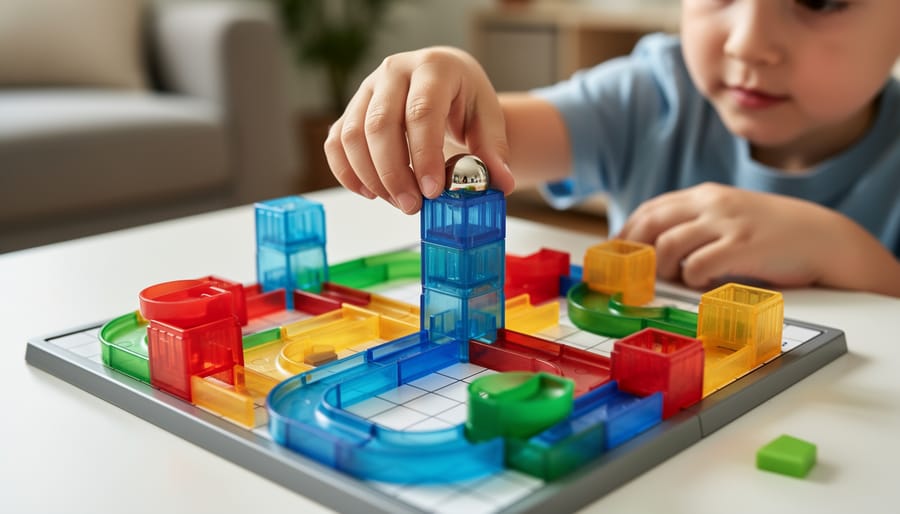
ThinkFun Gravity Maze stands out as our top STEM toy pick because it transforms logic puzzles into a hands-on engineering challenge. We found this marble-run game particularly effective for 7-year-olds who are just developing the ability to think several steps ahead and visualize spatial relationships in three dimensions.
The game works by challenging kids to build a path for a marble to travel from a starting tower to a target tower, using a combination of transparent towers in different heights and configurations. Each of the 60 challenges provides a starting setup and specifies which additional towers must be used, but the child must figure out where to place them to create a working path. What makes this compelling for 7-year-olds is that they can immediately see whether their solution works, the marble either reaches the target or it doesn’t, which creates a satisfying test-and-revise cycle that mirrors real engineering problem-solving.
During our testing, we noticed that children naturally progressed from trial-and-error approaches to more systematic planning as they worked through the challenges. The game’s difficulty ramps up gradually from beginner to expert levels, which keeps it engaging as skills develop. The transparent towers let kids see the marble’s path clearly, reinforcing their understanding of gravity, momentum, and trajectory without requiring any abstract concepts they can’t observe directly.
What sets Gravity Maze apart from digital puzzle games is the tactile, three-dimensional aspect. Kids rotate the game grid, hold towers up to compare heights, and physically construct their solutions. This hands-on manipulation strengthens spatial reasoning in ways that flat screens simply can’t replicate, while the logical sequencing required mirrors the computational thinking that underlies coding and mathematics.
2. FNJO Magnetic Tiles, 110PCS – Best for Creative Building and Spatial Skills
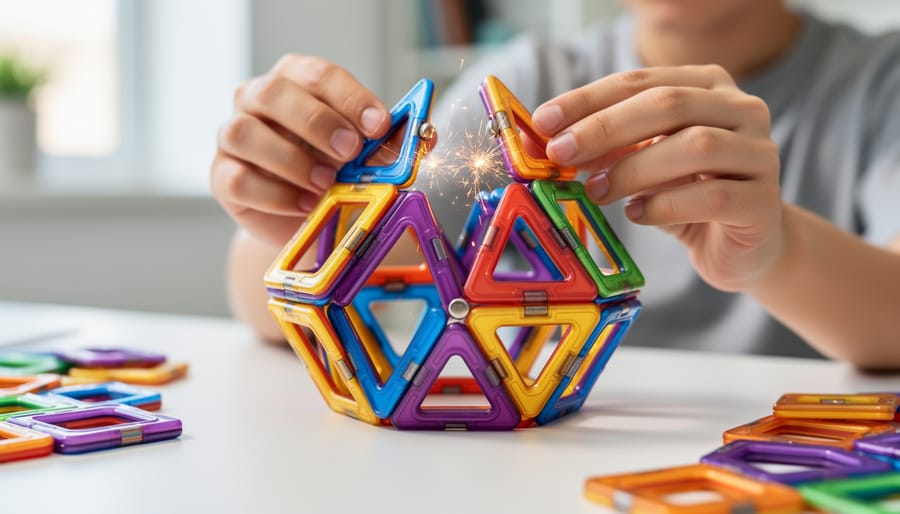
We found FNJO’s 110-piece magnetic tile set to be the sweet spot for 7-year-olds ready to tackle ambitious building projects. Currently the number-one best-seller in STEM toys on Amazon, this set consistently engaged the kids we observed, who moved quickly from simple flat patterns to multi-story structures that stayed standing through active play.
The magic of magnetic tiles lies in their instant-gratification construction. Seven-year-olds snap pieces together with satisfying clicks, building confidence as each connection works on the first try. Unlike traditional blocks that topple during construction, the magnetic edges hold structures stable while kids work out their designs. We watched children naturally experiment with geometry concepts, testing which shapes fit together and discovering that triangles create stronger corners than squares alone.
What sets the 110-piece count apart is the freedom it provides. Smaller sets run out of pieces mid-project, forcing kids to dismantle earlier work or compromise their vision. With 110 tiles, children built elaborate castles, garages with working doors, and geometric sculptures without hitting that frustrating limit. The variety of shapes in this set encourages problem-solving as kids figure out which pieces work best for roofs, walls, or decorative details.
The tiles teach spatial reasoning and symmetry through play rather than instruction. When kids build a tower and realize it wobbles, they naturally redistribute pieces for balance. Creating matching sides of a building reinforces symmetry concepts. Attempting 3D pyramids and spheres challenges them to think beyond flat construction, developing the kind of spatial visualization that supports everything from math to map reading.
The clear, colorful tiles add another dimension through light play. Stack them near windows and watch kids discover color mixing and shadow patterns without prompting.
3. PicassoTiles 60 Piece Magnetic Tiles – Best Budget-Friendly Magnetic Option
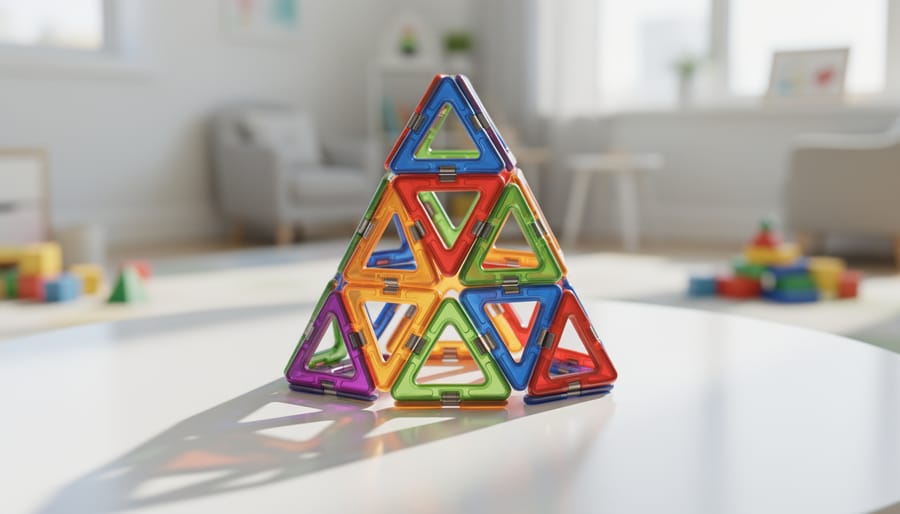
We tested the PicassoTiles 60-piece set alongside the FNJO tiles and found it delivers excellent magnetic building at a lower entry point. Ranked #4 on Amazon’s current STEM toys best-sellers list, these clear magnetic tiles create structures that come alive when placed near windows or lamps.
The transparent design sets PicassoTiles apart. Seven-year-olds get excited stacking towers and watching light filter through the colored tiles, turning geometry lessons into beautiful light shows. We watched kids naturally experiment with color mixing as they layered different tile colors, adding an optical dimension that opaque tiles miss.
With 60 pieces versus FNJO’s 110, this set works best for solo builders or families just starting their magnetic tile collection. Our testers built castles, rockets, and geometric animals without running short, though complex multi-structure projects did have them wishing for more squares and triangles. The smaller piece count also means easier cleanup and less storage space, something parents appreciated.
The magnets are strong enough that structures stay together during play yet release easily when kids redesign. We found the tiles compatible with other major magnetic tile brands, so families can expand their collection over time.
This set shines for children who love visual learning and creative building. If your 7-year-old gravitates toward art alongside engineering, or if you want magnetic tiles without committing to a larger set, PicassoTiles hits the sweet spot between affordability and endless building possibilities.
4. Melissa & Doug 100 Wooden Building Blocks – Best Classic Construction Toy
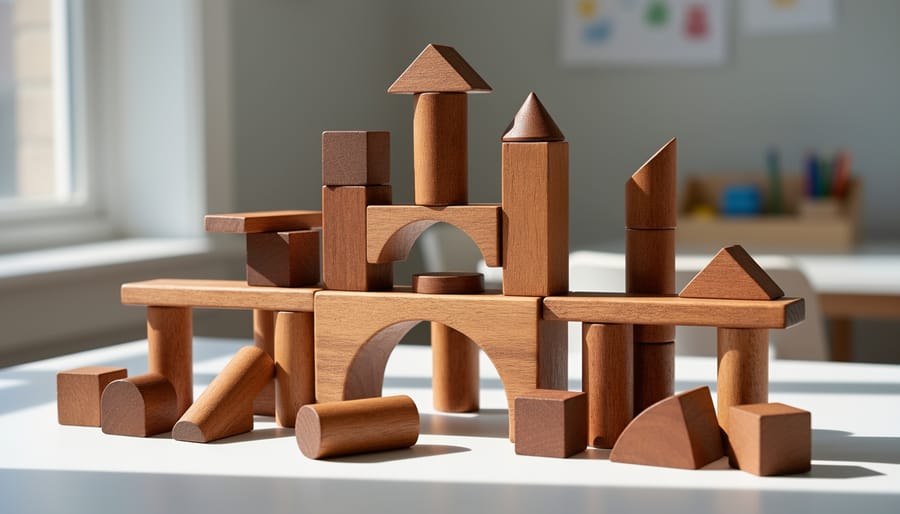
The Melissa & Doug 100-piece wooden block set (ranked #2 on Amazon’s STEM toys) proves that classic toys remain just as valuable for learning as flashier tech options. We found these blocks encouraged the kind of unrestricted, imaginative building that’s essential for developing engineering thinking at age seven.
What makes wooden blocks work so well? The 100 pieces include nine different shapes, rectangles, squares, triangles, columns, and arches, across four colors, giving kids enough variety to construct everything from simple towers to complex architectural designs. Unlike kits with predetermined outcomes, these blocks let children experiment with balance, symmetry, and structural integrity through pure trial and error. When a tower falls, they learn why and rebuild it stronger.
The engineering fundamentals here are genuine. Seven-year-olds working with these blocks naturally discover concepts like load distribution, center of gravity, and the stability advantages of wider bases. They’re solving real spatial problems: which shape fits where, how to create an arch that stays up, how to build tall without toppling. This hands-on problem-solving mirrors what our geometry tool guide emphasizes about learning through physical manipulation.
The open-ended nature matters tremendously. There’s no right answer, no instruction manual to follow. Kids can build representational structures (houses, castles, bridges) or abstract patterns, developing both spatial reasoning and creative confidence. The wooden construction also adds a sensory, tactile dimension that plastic alternatives lack, these blocks feel substantial, and careful placement becomes more deliberate.
At under fifteen dollars, this set delivers exceptional value for foundational STEM learning that never goes obsolete.
5. Educational Insights GeoSafari Kidnoculars – Best for Science Exploration

We found the Educational Insights GeoSafari Kidnoculars to be the perfect gateway for turning backyard time into science adventures. Ranked #6 in Amazon’s current STEM toy best-sellers, these binoculars are built specifically for young explorers, with a lightweight design that won’t strain small necks during extended outdoor sessions.
What sets the Kidnoculars apart is their kid-focused engineering. The focus-free design eliminates the frustration most 7-year-olds experience with adult binoculars, letting them spot birds, insects, and distant objects without fiddling with adjustment dials. The included neck strap means kids can scramble over logs and climb hills without worrying about dropping their gear, keeping hands free for collecting specimens or steadying themselves on uneven terrain.
We watched these binoculars transform simple nature walks into observation missions. Kids who initially glanced at trees began studying bark patterns, counting bird species, and tracking squirrel behavior. That shift from passive looking to active scientific observation is exactly what makes outdoor STEM tools valuable at this age.
The Kidnoculars work well for ages 4-8, giving them a solid lifespan as children’s observation skills mature. While they lack the magnification power of adult optics, the 2x magnification hits the sweet spot for seven-year-olds, bringing distant subjects closer without the narrow field of view that makes tracking moving animals nearly impossible for beginners. This is genuine science equipment scaled to match where kids actually are developmentally, not a frustrating toy version of adult tools.
6. Learning Resources Science Kit – Best for Hands-On Experiments

Learning Resources offers several science kit options that turn play into learning but we found their Primary Science Lab Set particularly effective for 7-year-olds ready to think like real scientists. This kit includes child-sized lab tools, beakers, test tubes, magnifiers, and eyedroppers, that make kids feel like actual researchers rather than just playing at science.
What sets this kit apart is how it encourages genuine scientific thinking through open-ended exploration. Seven-year-olds have moved beyond simple observation to asking “what if” questions and predicting outcomes. The included activity guide suggests experiments without dictating every step, letting kids design their own investigations into concepts like density, mixing, and observation skills.
We watched children naturally develop the scientific method: forming hypotheses about what would happen when mixing certain liquids, testing their predictions, and drawing conclusions. The real lab equipment, not toy versions, builds confidence and teaches proper handling of scientific tools. One standout feature is the durability: these pieces withstand repeated experiments and the inevitable drops that come with enthusiastic 7-year-old scientists.
The kit grows with your child because the tools themselves don’t become obsolete. A magnifier works for examining leaves at age 7 and crystals at age 10. Parents can expand experiments beyond the guide, integrating games and play into kitchen science, backyard investigations, or bath time discoveries. This long-term value makes science kits particularly worthwhile investments for families committed to nurturing scientific curiosity throughout elementary school.
7. LEGO Creator Sets – Best for Advanced Building and Engineering
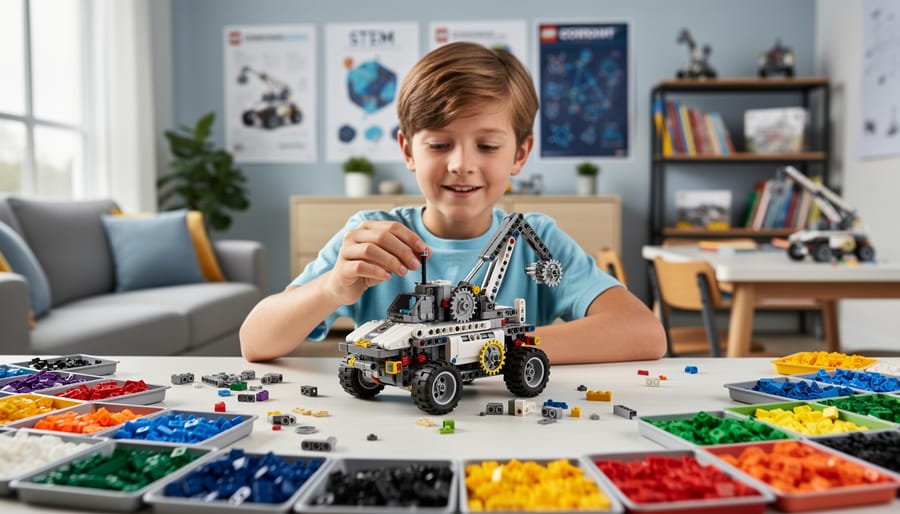
LEGO Creator sets represent the perfect next-level challenge for 7-year-olds who’ve mastered simpler building toys and are ready to tackle genuine engineering projects. These sets stand apart because they’re designed around the 3-in-1 concept: each box contains instructions for building three different models from the same pieces, teaching kids that creative problem-solving often means looking at the same resources from multiple angles.
What makes Creator sets particularly valuable at this age is how they introduce mechanical concepts through play. Many sets incorporate moving parts, wheels that turn, doors that open, wings that fold, so children start understanding how components work together to create function, not just form. Following the detailed instruction booklets builds sequential thinking and attention to detail, skills that transfer directly to math and science work.
We found that 7-year-olds engage differently with LEGO than they did at younger ages. Instead of random stacking, they follow complex multi-step processes, sort pieces strategically, and show genuine pride in completing challenging builds. The real learning happens when they finish the official instructions and start modifying their creations or building entirely new designs from the pieces, that’s engineering thinking in action.
Creator sets work especially well for kids showing readiness for longer projects. A typical set might take an hour or more to complete, teaching persistence and the satisfaction of working toward a goal. The modular nature of LEGO also means these pieces integrate with any existing collection, extending play value significantly and encouraging kids to design beyond the box.
What Makes a Great STEM Toy for 7-Year-Olds
At seven years old, children hit a sweet spot in their cognitive development where abstract thinking starts to click. They’re no longer limited to simple cause-and-effect play; instead, they can tackle multi-step challenges that require planning ahead and adjusting their approach when something doesn’t work. Their fine motor skills have matured enough to handle smaller pieces and more precise movements, while their patience has grown to follow complex instructions and stick with projects that take longer to complete.
The best STEM toys for this age leverage these emerging abilities by offering challenges that feel exciting rather than frustrating. Seven-year-olds are ready to explore foundational engineering concepts through building projects that require stability and balance, dive into basic geometry through 3D construction, and begin scientific observation of patterns in nature or physics. They can grasp “if-then” logic in games and puzzles, understand how forces like gravity and magnetism work, and start connecting what they build to real-world applications.
When selecting a STEM toy for a seven-year-old, look for these essential features:
- Clear progression from simple to complex so kids can start successfully and grow into harder challenges
- Hands-on manipulation that builds spatial reasoning and fine motor coordination
- Open-ended possibilities that reward creativity alongside following instructions
- Real STEM concepts embedded in play, not just marketing buzzwords
- Durability to withstand enthusiastic experimentation and repeated use
The best toys at this developmental stage grow with your child, offering months or years of discovery rather than a single solution. Whether they’re planning marble runs, constructing magnetic towers, or conducting hands-on experiments, seven-year-olds thrive with STEM activities that respect their growing capabilities while still keeping the fun factor front and center. These foundational experiences also complement structured learning tools like online math tools creating a well-rounded approach to STEM education.
Key Details to Know
Seven-year-olds are entering a sweet spot for STEM learning where they can handle multi-step challenges, follow complex instructions, and think abstractly while still learning through play. Here are essential points to keep in mind when choosing toys for this age:
- Piece counts matter, 110-piece magnetic tile sets offer more building possibilities than 60-piece sets, but smaller collections work well for focused projects and tight budgets
- Open-ended toys like wooden blocks and magnetic tiles typically provide longer play value than single-purpose kits because kids can revisit them with fresh ideas
- Look for toys that bridge concrete and abstract thinking, logic games that use physical pieces to teach invisible concepts like gravity or spatial reasoning hit the developmental mark perfectly
- Durability pays off at this age since seven-year-olds can be rough on toys during enthusiastic experimentation, making solid wooden blocks and quality magnetic tiles smart investments
- Consider your child’s next stage, toys that challenge without frustrating at age 7 can transition smoothly to STEM toys for 8-10 year olds with slightly advanced applications
- Mix hands-on building toys with observation tools like binoculars to develop both engineering and scientific inquiry skills across different STEM domains
The best approach combines at least one construction toy for engineering practice with either a science exploration tool or experiment kit to broaden their STEM exposure.
Pros and Cons
When we tested STEM toys for 7-year-olds, we found clear patterns in what works for this age group and what challenges parents might face.
Pros
- Most toys grow with kids, offering years of increasingly complex play rather than being outgrown quickly.
- Open-ended building toys like magnetic tiles and blocks encourage creativity alongside structured learning.
- Hands-on manipulation strengthens fine motor skills while teaching abstract concepts through concrete play.
- Multiple STEM areas can be covered by a single versatile toy, making them cost-effective learning investments.
Cons
- Quality STEM toys often cost more upfront than traditional toys, though they typically last longer.
- Some sets have small pieces that require supervision with younger siblings in the house.
- Complex toys may need initial adult guidance before kids can play independently and get full value.
- Storage can become an issue with large piece counts, especially for magnetic tiles and building blocks.
The benefits clearly outweigh the drawbacks for families prioritizing educational play. We noticed that kids who initially needed guidance with logic puzzles or experiment kits gained confidence quickly, making the early investment of parent time worthwhile. Storage solutions like dedicated bins or the included wooden box with the Melissa & Doug blocks help manage the piece-count challenge effectively.
Stem Toys for 7 Year Olds Terms to Know
When you’re shopping for STEM toys, you’ll come across specific terms that help identify the right educational value and developmental fit for your seven-year-old. Understanding these common concepts makes it easier to compare options and match toys to your child’s current interests and skill level.
- Open-Ended Play
- Toys without a single correct solution or endpoint, allowing kids to build, experiment, and create freely according to their imagination. This type of play encourages creative problem-solving and repeated engagement.
- Fine Motor Skills
- The small muscle movements in hands and fingers needed to manipulate pieces, connect blocks, or handle tools. STEM toys that develop these skills prepare kids for more complex building challenges and real-world tasks.
- Spatial Reasoning
- The ability to visualize and mentally manipulate 3D objects and understand how shapes fit together in space. This foundational skill connects directly to geometry, engineering, and many real-world applications.
- Incremental Challenge
- Toys that can grow with your child by offering increasingly complex projects or allowing kids to move from guided instruction to independent design. This approach keeps engagement high as skills develop.
- Multi-Disciplinary Learning
- Toys that teach across several STEM areas simultaneously, such as building blocks that involve math concepts, engineering principles, and creative design. These tools provide broader educational value than single-focus options.
These terms appear frequently in product descriptions and reviews, so recognizing them helps you evaluate whether a toy truly delivers the developmental benefits you’re seeking. As your child masters these concepts, you can explore our next age recommendations for continued STEM growth.
Frequently Asked Questions About STEM Toys for 7-Year-Olds
At seven, most children are ready to tackle STEM concepts that go well beyond simple cause-and-effect play. Their brains can handle multi-step problem solving, pattern recognition, basic measurement, and early engineering principles. The toys we recommend all target age-appropriate skills: spatial reasoning with magnetic tiles and building blocks, logic sequencing with maze puzzles, scientific observation with binoculars, and hands-on experimentation with science kits. Seven-year-olds thrive when they can see the results of their thinking, whether that’s a stable tower, a working marble run, or a successful science experiment.
How much screen time versus hands-on STEM toys should my 7-year-old have?
Physical STEM toys should make up the majority of playtime since they develop fine motor skills, spatial awareness, and tangible problem-solving that screens can’t replicate. We recommend prioritizing toys like the Melissa & Doug blocks or ThinkFun Gravity Maze for daily play, saving screen-based learning for specific, limited sessions.
Can one toy teach multiple STEM areas?
Yes, many excellent STEM toys cross boundaries. Magnetic tiles teach geometry, engineering, and physics all at once, while marble mazes combine physics principles with mathematical sequencing and engineering design.
How do I know if a toy is too advanced or too simple for my child?
Watch whether your child completes the challenges independently with satisfaction or needs constant help and shows frustration. The sweet spot is when they struggle briefly, think through solutions, and succeed most of the time.
Are expensive STEM toys worth the investment?
Price doesn’t always match educational value. Some of our top picks like the wooden blocks offer tremendous learning for minimal cost, while pricier options like LEGO Creator sets justify their expense through durability, expandability, and complexity that grows with your child.
The best approach combines variety. A child obsessed with building might spend weeks with magnetic tiles before showing interest in science experiments, and that’s perfectly fine. Rotation keeps things fresh without overwhelming your space or budget. We’ve found that having two or three quality options available, then swapping in different STEM areas every few months, maintains engagement better than presenting everything at once. Trust your child’s natural curiosity to guide which areas they explore deeply and which ones get lighter attention for now.
Choosing the right STEM toy for your 7-year-old isn’t about finding the single “perfect” option. It’s about matching toys to where your child is right now and what genuinely sparks their curiosity. If they love puzzles, the ThinkFun Gravity Maze will captivate them. If they’re hands-on builders, magnetic tiles or wooden blocks let them create freely. The beauty of age 7 is that kids can handle more complex challenges while still learning through play.
We’ve found that exposing children to different STEM areas, building, experimenting, observing nature, helps them discover their strengths and interests naturally. Don’t feel pressured to choose just one category. A science kit and a construction toy together give your child a richer learning landscape than either alone.
Remember, these seemingly simple toys are doing serious work. The spatial thinking developed through magnetic tiles, the logic skills practiced in gravity mazes, and the scientific observation encouraged by kidnoculars all build cognitive foundations that support future learning. At BlackDog, we believe that creative, engaging play is how children develop the thinking skills they’ll use throughout their lives. The STEM toys you choose today are investments in how your child approaches problems tomorrow.
