
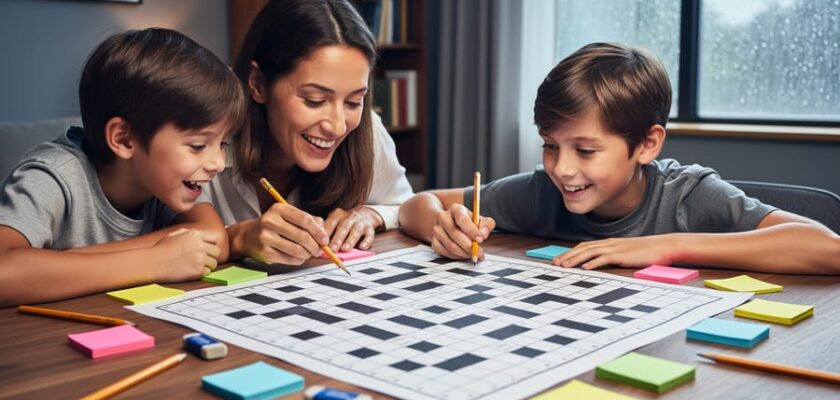
Jumbo crossword puzzles are oversized versions of traditional crosswords, featuring larger grids (often 21×21 squares or bigger), more clues, and extended solving time that can stretch across multiple sittings. These brain-bending puzzles typically contain 150 to 200 clues, making them perfect for family collaboration, long car trips, or rainy weekend projects where kids and adults can work together as a puzzle-solving team.
What sets jumbo crosswords apart isn’t just their size. The expanded grid creates space for longer answers, more complex wordplay, and a satisfying challenge that rewards persistence without the frustration of impossible difficulty. For families with young learners, these puzzles become natural teaching tools: older children (ages 9-12) can tackle sections independently while younger kids (ages 5-8) contribute by searching for three- and four-letter answers, practicing spelling, and building vocabulary in context.
The collaborative nature transforms puzzle-solving from a solitary activity into an interactive learning experience. Parents and educators find that working through a single jumbo puzzle over several days creates opportunities to discuss word meanings, explore prefixes and suffixes, and celebrate small victories as sections get completed. Unlike standard crosswords that might be finished in a single session, jumbo puzzles offer sustained engagement, making them ideal for building stamina, pattern recognition, and problem-solving strategies.
Whether you’re introducing your kindergartner to their first crossword clues or challenging your fifth-grader with wordplay and puns, jumbo crosswords provide a flexible, screen-free activity that grows with your child’s abilities.
What Makes a Crossword ‘Jumbo’?
When you see the word “jumbo” slapped onto a crossword puzzle, you might picture a physically enormous sheet of paper spread across your kitchen table. And you’d be right, sometimes. But jumbo crosswords are more than just big paper. They’re a whole different puzzle experience defined by their expanded grids, increased clue counts, and the collaborative fun they create.
The technical difference starts with size. While standard daily newspaper crosswords typically measure 15×15 squares, jumbo puzzles kick things up several notches. Most jumbo grids start at 21×21 squares, though some ambitious versions stretch to 23×23 or even larger. That’s not just a few extra squares, it’s exponentially more empty boxes to fill and significantly more brain power required to complete them.
- Grid Size
- Jumbo crosswords feature grids of 21×21 squares or larger, compared to the standard 15×15 format. This expansion creates more intersecting words and a more complex solving challenge.
- Clue Count
- With bigger grids come more clues, often 130 to 170 or more, compared to around 70-80 in standard puzzles. That’s nearly double the vocabulary workout packed into one puzzle.
- Difficulty Levels
- Jumbo puzzles can range from beginner-friendly themed grids to expert-level brain twisters. The larger format allows constructors to include both easy fill-in answers and challenging wordplay within the same puzzle.
- Formats
- These puzzles appear as oversized printed sheets, puzzle books, or digital versions on apps and websites. Each format offers different advantages for group solving and educational use.
The Jumbo puzzle size definition confirms what puzzle enthusiasts already know: jumbo crosswords demand more time, patience, and persistence than their smaller cousins. A standard crossword might take 20-30 minutes for an experienced solver, while a jumbo can easily stretch into hours or even days of solving.
What makes these puzzles especially valuable for families and classrooms is their group-friendly nature. The sheer number of clues means multiple people can work different sections simultaneously without getting in each other’s way. That physical or digital sprawl transforms solitary puzzle time into a shared adventure.
Brain-Boosting Benefits for Young Puzzlers
Jumbo crossword puzzles pack serious learning power into their oversized grids. When kids wrestle with these brain-stretchers, they’re building skills that reach far beyond vocabulary lists.
Vocabulary That Sticks
Every clue introduces words in context, not through rote memorization but through active problem-solving. A child figuring out that “nocturnal flyer” means “bat” creates a mental connection stronger than any flashcard. The larger grid size means exposure to 50-100+ words in a single session, with repetition across different puzzles cementing spelling patterns and definitions.
Critical Thinking in Action
Unlike word search puzzles where letters sit waiting to be found, crosswords demand active reasoning. Kids must decode clues, consider multiple meanings, test answers against intersecting words, and revise when something doesn’t fit. This trial-and-error process mirrors scientific method, hypothesis, test, adjust, building comfort with productive failure.
Pattern Recognition and Logical Deduction
Jumbo puzzles teach systematic thinking. Kids learn to start with the easiest clues, use completed answers as scaffolding for tougher ones, and work section by section rather than randomly jumping around. They spot common letter patterns (words ending in -ing or -tion), recognize prefixes and suffixes, and use logic to eliminate impossible answers. These are the same analytical skills programmers use to debug code.
Persistence Pays Off
A jumbo puzzle might take hours or even days to complete. That sustained effort teaches grit. Kids experience the satisfaction of returning to a stuck section with fresh eyes, finally cracking a tough clue, or watching a blank grid slowly fill in. Among educational game types few offer such tangible evidence of incremental progress.
Teamwork and Communication
When families tackle jumbo puzzles together, kids practice explaining their reasoning, listening to others’ ideas, and negotiating solutions. They learn that combining different knowledge bases, one child strong in science terms, another in geography, makes hard problems manageable.
These brain-boosting benefits accumulate with every puzzle, building a foundation for complex problem-solving across subjects.
Age-Appropriate Jumbo Puzzles: Finding the Right Fit
For Beginning Puzzlers (Ages 5-7)
For your youngest crossword enthusiasts, look for jumbo puzzles designed like colorful playmats rather than intimidating grids. The best beginner options feature large, easy-to-read squares with three- to five-letter words drawn from everyday vocabulary kids already know, think “cat,” “sun,” “play,” and “jump.” Picture clues work wonderfully at this stage: instead of reading “a pet that barks,” your child sees a dog illustration next to the numbered square. Themed grids built around familiar topics like farm animals, playground equipment, or favorite foods help kids make confident connections. These puzzles shine brightest as parent-child projects where grown-ups read clues aloud, offer encouraging hints, and celebrate each completed word with high-fives, turning what could feel overwhelming into bite-sized victories that build early literacy skills.
For Developing Solvers (Ages 8-10)
At this stage, your young solver is ready to tackle crosswords that look more like the grown-up versions, just with friendlier content. Look for jumbo puzzles featuring vocabulary from their reading level: think “equation” instead of “add,” or “explore” instead of “look.” These puzzles should include words spanning six to ten letters, giving kids practice with spelling patterns and compound words they’re encountering in school.
Themed jumbo crosswords work especially well for this age group. A space exploration grid might include terms like “astronaut,” “satellite,” and “gravity,” reinforcing science concepts while building puzzle skills. The best intermediate puzzles offer a mix: some clues your child can solve independently (“A red planet” for Mars), while others might need a quick discussion or reference check. This balance keeps frustration low while encouraging problem-solving persistence.
Watch for puzzles labeled “ages 8-10” or “grade 3-5” that specifically mention educational themes. These often weave in vocabulary from subjects like geography, history, or nature, turning puzzle time into sneaky learning time.
For Advanced Young Puzzlers (Ages 11-12)
By ages 11-12, kids are ready for genuinely challenging jumbo puzzles that mirror adult difficulty while staying age-appropriate. Look for crosswords featuring sophisticated wordplay, clues that use puns, double meanings, or require lateral thinking (“What kind of pool can’t you swim in?” for CARPOOL). Subject-specific themes work brilliantly at this level: science terminology, historical figures, literary references, or geography challenges that connect to middle school curricula. These puzzles should include longer answer words (8-15 letters) and cryptic-style clues that reward careful reading. Competitive elements become motivating now, timed solving sessions with friends, tracking personal best completion times, or collaborative races between teams. Advanced young puzzlers thrive when puzzles respect their intelligence without oversimplifying, offering the satisfaction of cracking truly tricky clues through persistence and creative thinking.
Turning Solo Puzzles into Team Adventures
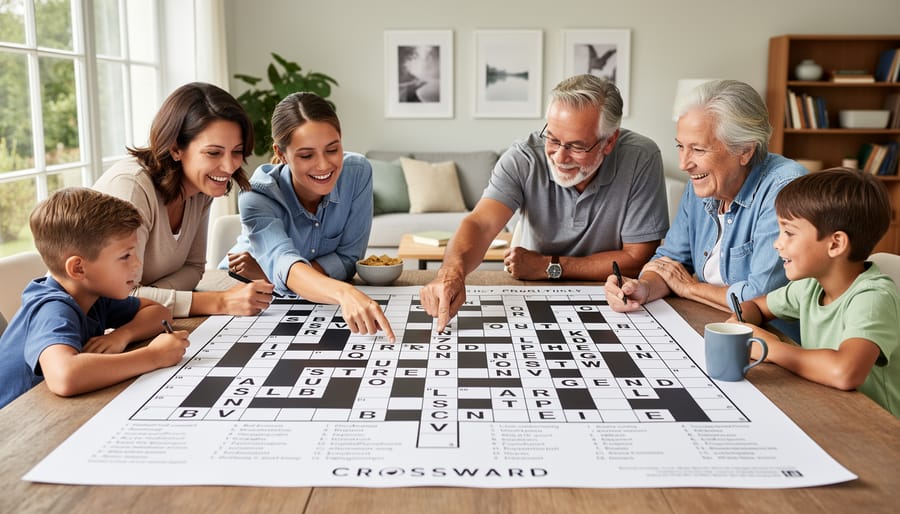
Jumbo crosswords work beautifully as group activities because their size naturally invites collaboration. Instead of one person hunching over a puzzle alone, spread that giant grid across a kitchen table or classroom floor and watch it become a shared mission.
Try dividing the puzzle into territories. Each family member or student claims a section, maybe someone tackles the top-left corner while another works the bottom-right. Set a timer for 10 minutes, then rotate. Kids love the game-like structure, and rotation prevents anyone from getting stuck too long in a tough spot. When sections connect and words suddenly make sense across territories, the aha moments feel like team victories.
Turn clue-reading into a role. Younger kids who can’t solve complex clues can still participate as the official “Clue Reader,” announcing each hint with dramatic flair. Older siblings or parents become the “Letter Fillers,” writing answers neatly into boxes. Rotate these jobs every few clues so everyone experiences different thinking modes.
Create milestone celebrations for jumbo puzzles. Completing the first 20 answers deserves a snack break. Finishing half the grid earns a victory dance. These checkpoints keep motivation high during what might otherwise feel like an endless challenge. For classrooms, chart progress on a separate poster and let students add stickers as sections fill in.
Competition works too, but keep it friendly. Challenge another family to see who finishes their jumbo puzzle first over a weekend, or split your class into teams racing to complete matching puzzles. The key is making the puzzle a reason to connect, laugh when you’re stumped, and cheer when someone cracks that tricky seven-letter word nobody saw coming.
Digital vs. Paper: Choosing Your Format
Both paper and digital jumbo crossword puzzles offer unique advantages for young learners, and the best choice often depends on your family’s situation and your child’s learning style.
Paper puzzles, whether printed poster-size or bound in books, provide a hands-on experience that many kids find satisfying. There’s something special about physically filling in squares with a pencil, erasing mistakes, and watching progress spread across a large grid. The tactile experience helps with fine motor skills and letter formation, particularly for younger children still mastering handwriting. Paper formats also encourage unplugged family time without screen distractions, and multiple people can gather around a single large puzzle spread on a table or hung on a wall.
Digital jumbo crosswords bring different strengths to the table. Apps and interactive websites often include hint systems, automatic error checking, and adjustable difficulty levels that adapt to a child’s skill. Some platforms track progress over time, showing improvement that reinforces learning. Digital formats also eliminate the need for physical storage and allow kids to work on puzzles anywhere, making them ideal for car trips or waiting rooms. Many incorporate gamification elements like badges or timed challenges that motivate certain learners.
Pros
- Paper puzzles build fine motor skills and handwriting practice through physical pencil work.
- Digital versions offer instant feedback and adaptive hints that help kids learn from mistakes.
- Large printed puzzles create natural gathering spaces for family collaboration.
- Apps and websites save space and travel easily, fitting entire libraries on one device.
Cons
- Paper puzzles require storage space and can’t be easily adjusted for difficulty once printed.
- Digital formats add screen time and may distract with notifications or other apps.
- Physical puzzles need good lighting and adequate workspace, limiting where kids can solve.
- Online versions may require subscriptions or internet access, creating barriers for some families.
Consider combining both formats to maximize benefits. Use paper puzzles for weekend family sessions when you want focused, screen-free time together. Turn to digital versions for solo practice during travel or when kids need immediate feedback to stay motivated. This hybrid approach connects to why STEM matters in education: exposing children to different problem-solving tools builds adaptability and helps them understand that multiple valid paths exist for tackling complex challenges.
Creating Your Own Jumbo Crossword Puzzle
Designing your own jumbo crossword transforms you from puzzle solver into puzzle architect. This creative flip requires planning, pattern recognition, and a touch of computational thinking, skills that mirror real programming challenges.
Start with graph paper and a theme. Choose a subject you know well: dinosaurs, space exploration, favorite books, or even your family’s inside jokes. List fifteen to twenty words related to your theme, mixing short words (three to five letters) with longer ones (seven to ten letters). The variety helps words intersect more easily.
The tricky part is fitting words together so they share letters at crossing points. This is algorithmic thinking in action. You’re solving a constraint problem: each vertical word must share exactly one letter with each horizontal word it crosses. Begin by placing your longest word horizontally across the middle of your grid. Then build outward, finding words that share letters with it. If “TELESCOPE” goes across, maybe “ORBIT” goes down through the “O.”
Digital tools make this process faster. Free puzzle-making websites let you type your word list, and they generate grids automatically, showing you the algorithm at work. For older kids comfortable with basic coding, platforms like Scratch can create simple crossword generators where you program the rules for word placement. You’re teaching the computer how to think through intersections.
Once your grid is complete, write clues. Make some straightforward (“The red planet” for MARS) and others playful (“What astronauts eat that’s out of this world” for SPACE FOOD). Test your puzzle on a family member. If they get stuck where you didn’t expect, you’ve learned something about clarity and difficulty balance.
Creating a jumbo crossword shows you the hidden structure behind every puzzle you solve. You’ve become both the architect and the engineer.
Common Challenges (And How to Overcome Them)
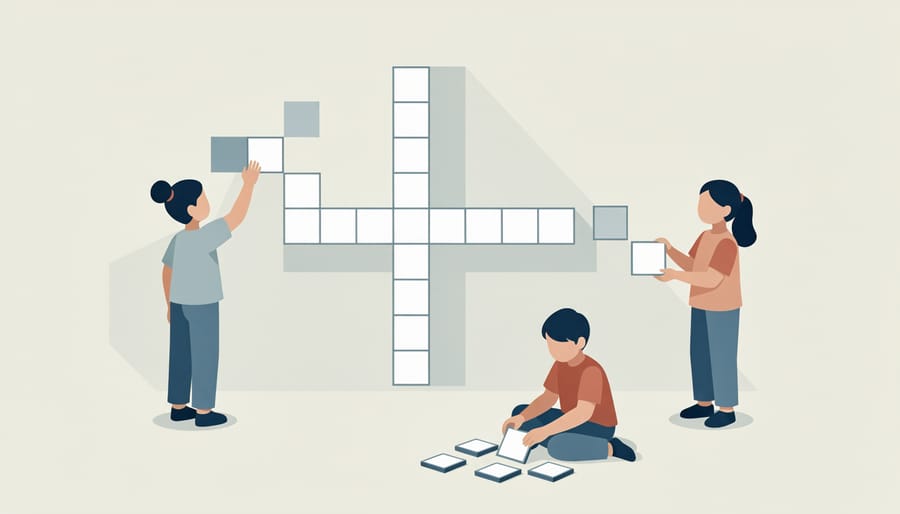
Giant crossword puzzles can feel like climbing a mountain when you’re staring at dozens of empty squares. The size alone might make your young solver want to give up before writing a single word. But here’s the secret: every puzzle champion started exactly where your child is now, and a few smart strategies turn that overwhelming grid into manageable chunks.
Start by dividing the puzzle into quadrants using a pencil to draw light lines. Your child can focus on conquering one quarter at a time, which feels far less intimidating than tackling 200+ clues at once. When they complete a section, celebrate with a sticker or checkmark, visible progress builds momentum and confidence.
Getting stuck happens to everyone, and that’s when crossword solver tools become valuable learning aids rather than cheats. Think of them as training wheels: they help your child understand clue patterns and word relationships while keeping frustration from killing their enthusiasm. Set a house rule like “three tries, then we look it up together” so they practice persistence without hitting a wall.
What if we get stuck on multiple clues?
Skip them and move to easier sections, you’ll often figure out stuck answers once surrounding letters appear. Circle tricky clues to revisit later.
How long should a jumbo puzzle take?
There’s no right answer! Some families work on one puzzle over several days, solving a section each evening. The journey matters more than speed.
Is using a dictionary or asking for help okay?
Absolutely, real puzzle experts use reference materials all the time. Learning how to find answers teaches research skills alongside vocabulary.
Patience wears thin after 20 minutes of puzzling, especially for younger kids. Build in natural break points: finish the across clues in one corner, then go play outside before tackling the down clues. Your child’s brain processes connections during breaks, so they’ll often return with fresh insights and renewed energy for those stubborn blank spaces.
Jumbo crossword puzzles prove that bigger really can be better when it comes to learning. These super-sized brain teasers transform what might feel like solitary homework into exciting family adventures and classroom celebrations. Whether you’re tackling a 21×21 grid on your kitchen table or collaborating on a poster-sized puzzle in your classroom, you’re building vocabulary, strengthening problem-solving skills, and creating memories that stick around long after the final square is filled.
This weekend, grab a jumbo puzzle that matches your child’s skill level and dive in together. Start with just one section. Celebrate when you crack a tricky clue. Take breaks when you need them. The beauty of jumbo crosswords is that they don’t demand perfection or speed. Every word you solve is a win, every pattern you recognize is progress, and every moment spent puzzling together builds confidence and curiosity.
Ready to think bigger? Your family’s first jumbo crossword adventure awaits.
