

Logic puzzles transform fourth graders into confident problem solvers who learn to break down complex challenges using pure reasoning. At this age, students are ready to move beyond simple brain teasers into structured logic grid puzzles, Sudoku variations, and deductive reasoning games that build critical thinking skills while keeping them genuinely engaged. The sweet spot for 4th grade logic puzzles lies in three-by-three and four-by-four grids that require tracking multiple clues without overwhelming young minds.
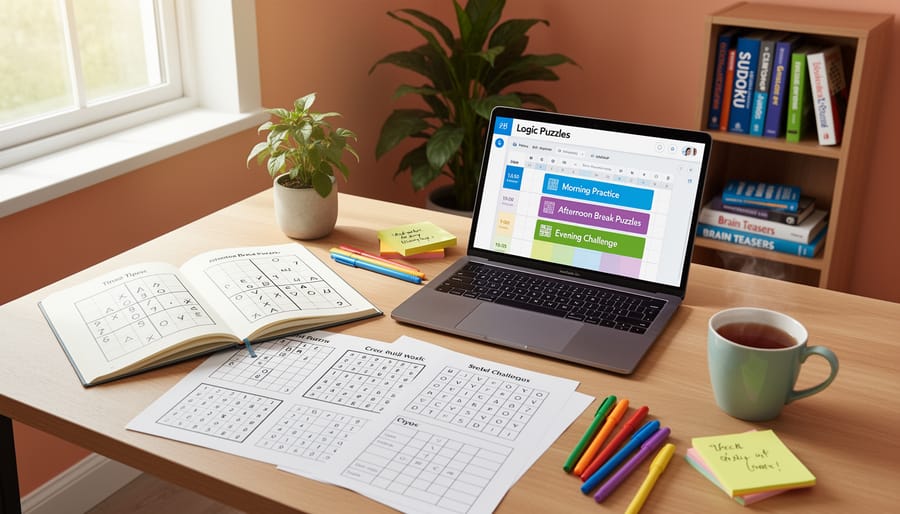
You’ll find puzzle sets designed specifically for this grade level available both as printable PDFs and paperless Google Slides versions, making them perfect for classroom centers, homeschool enrichment, or quiet afternoon activities. The best options align with Common Core standards and offer clear difficulty progression, starting with medium-level grids before advancing to more challenging formats. These puzzles work wonderfully for gifted learners who finish assignments early, rainy-day brain breaks, or dedicated logic practice sessions.
What makes logic puzzles particularly powerful for 9- and 10-year-olds is how they strengthen skills that reach far beyond the puzzle itself. Kids learn to organize information systematically, test hypotheses, eliminate impossible answers, and persist through tricky problems. They’re building the same kind of analytical thinking they’ll use in math word problems, science experiments, and reading comprehension, all while having fun cracking codes and solving mysteries.
Why Logic Puzzles Work Wonders for Fourth Graders
Fourth graders sit at a cognitive sweet spot for logic puzzles. At this age, their brains are developing abstract thinking skills that let them hold multiple pieces of information in their heads at once and test different possibilities. When kids work through clues to eliminate wrong answers and arrive at the one correct solution, they’re practicing deductive reasoning, the same skill mathematicians and scientists use every day.
These puzzles also build persistence in a low-stakes way. Unlike timed tests or graded assignments, logic puzzles let kids struggle productively and experience the satisfaction of cracking a tough problem through their own reasoning. That “aha!” moment teaches them that challenging tasks become manageable when you break them down systematically. The pattern recognition skills they develop translate directly to math, coding, reading comprehension, and science, making logic puzzles a powerful tool for STEM enrichment without feeling like extra homework.
How We Chose These Logic Puzzles
We handpicked these logic puzzles by focusing on what fourth graders need and what actually works in real learning environments. Each puzzle made our list because it checks multiple boxes for parents and teachers seeking high-quality brain teasers.
Our selection criteria included:
- Age-appropriate difficulty that challenges without overwhelming 4th grade reasoning skills
- Format flexibility, from printable PDFs to paperless Google Slides versions for different settings
- Skill progression from beginner 3×3 grids through challenging 4×4 layouts
- Alignment with Common Core State Standards for Math and critical thinking
- Engaging themes and contexts that hold kids’ attention
We looked for puzzles that fit diverse situations: homeschool lessons, classroom centers, early finisher activities, rainy-day entertainment, and gifted enrichment. The puzzles range from straightforward logic grids to higher-order thinking challenges that stretch mathematical reasoning. We prioritized variety because different puzzle types exercise different cognitive muscles, and fourth graders thrive when they can sample multiple approaches to logical problem-solving. Whether you need a quick five-minute brain break or a deep-dive challenge, these seven puzzle types deliver.
1. Logic Grid Puzzles with 3×3 Grids
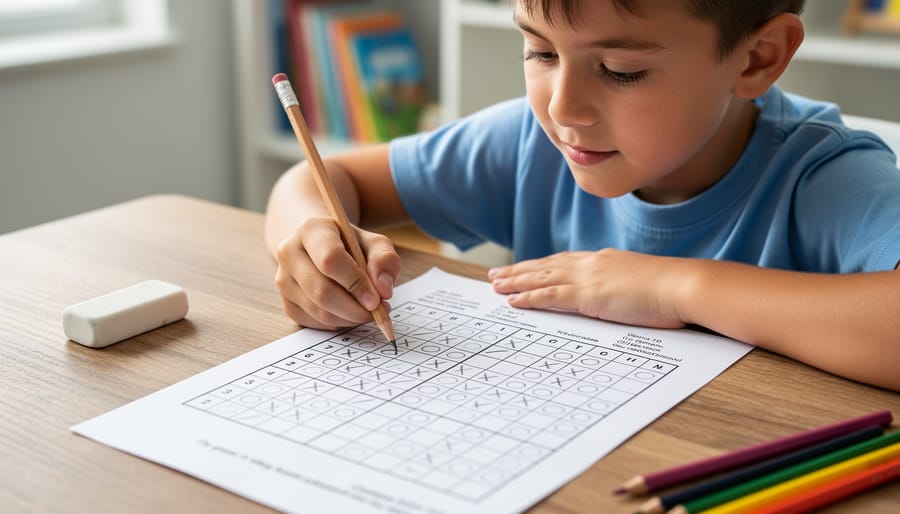
Logic grid puzzles with 3×3 grids are the perfect starting point for fourth graders stepping into the world of deductive reasoning. Each puzzle presents a scenario, like matching kids to their favorite ice cream flavors or pets to their owners, along with a set of clues. Your child reads each clue, marks what’s possible and what’s not on the grid, and gradually eliminates options until only one answer fits every rule.
The beauty of a 3×3 setup is its manageable size. Fourth graders can see the whole puzzle at once without feeling overwhelmed, yet they still get that satisfying “aha!” moment when the final pieces click into place. These puzzles teach kids to track multiple pieces of information, spot contradictions, and think several steps ahead, all skills that transfer to math problem-solving and reading comprehension.
Teachers love 3×3 logic grids for classroom centers because they’re quick enough for a 15-minute rotation but challenging enough to keep early finishers engaged. Homeschooling parents appreciate how they turn quiet learning time into an independent thinking exercise. Start with these grids, and you’ll watch your fourth grader build confidence before tackling more complex puzzles.
2. Math Logic Puzzles with Higher-Order Thinking
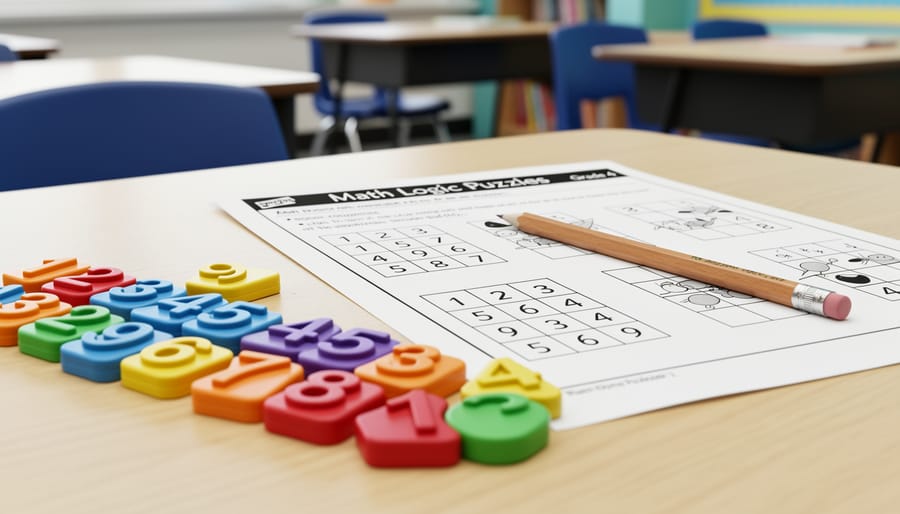
Math logic puzzles take reasoning skills to the next level by blending number sense with deductive thinking. Instead of just solving equations, fourth graders must analyze relationships between numbers, apply rules, and eliminate impossible answers to crack each challenge.
Sets designed specifically for 4th grade enrichment offer exactly the right level of difficulty. For example, 14-puzzle collections aligned with Common Core State Standards for Math give students practice with concepts they’re learning in class while stretching their problem-solving muscles. These puzzles ask questions like “If Amy scored 12 more points than Ben, and Ben scored half as many as Carlos, who finished with 36 points, what did each player score?” Kids love the detective work of piecing together the answer step by step.
The beauty of math logic puzzles is flexibility. Many are available both as printable PDFs for pencil-and-paper solving and as paperless Google Slides versions for digital learning. This means you can slip a few printables into your homeschool binder, project them on the classroom board for group problem-solving, or assign the digital version to early finishers who need an extra challenge without making more copies.
3. Challenging 4×4 Logic Grid Puzzles

Once your fourth grader has conquered 3×3 grids, 4×4 logic grid puzzles offer the perfect next challenge. These puzzles add an extra category and more clues, which means students need to track more information and think several steps ahead before marking any box.
The jump from three to four categories might sound small, but it makes a real difference. Kids learn to organize their thinking, double-check their reasoning, and stick with a puzzle even when the solution isn’t obvious after the first few clues. This builds the kind of persistence that helps in math, science, and everyday problem-solving.
These puzzles shine for gifted learners who breeze through easier grids and crave something meatier. They also work beautifully for early finishers, students who zip through classwork can tackle a 4×4 grid at their desk without disrupting others. You’ll find these puzzles in sets that use both grid sizes, so you can match difficulty to each child’s experience level rather than age alone.
4. Story-Based Logic Puzzles
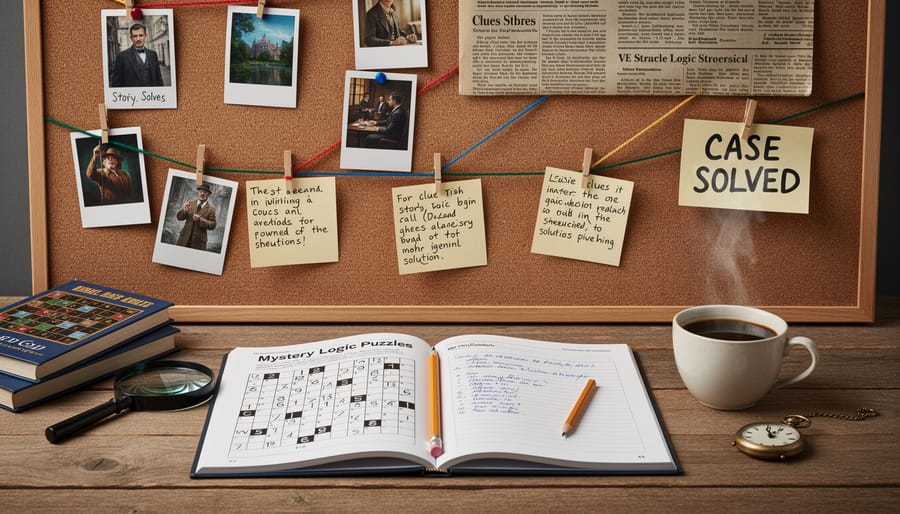
Story-based logic puzzles wrap deductive reasoning challenges inside a narrative, transforming clues into plot points and solutions into solved mysteries. Fourth graders who might groan at a plain grid of facts often light up when the same puzzle asks them to figure out which detective cracked the case or which character owns the missing treasure.
These puzzles work exactly like traditional logic grids: students read clues, eliminate impossible combinations, and deduce the one correct answer. The difference is context. Instead of “Person A likes blue,” the clue might read, “The spy who arrived at midnight doesn’t wear a red disguise.” Suddenly, logic feels like an adventure.
Murder-mystery themed sets have become popular for this age group, offering dozens of puzzles where kids play detective to solve whodunits using evidence grids. Some themed collections even combine story puzzles with escape room games, layering multiple challenges into one thrilling scenario. These formats shine in classroom centers, rainy-day activities, or any time you need to hook a reluctant problem-solver.
The narrative hook keeps kids engaged longer, building stamina for tougher reasoning. They’re practicing the same critical thinking skills as any logic grid, they just don’t realize they’re working that hard because they’re too busy cracking the case.
5. Escape Room Logic Puzzle Games

Escape room games bundle logic grid puzzles into a thrilling adventure that keeps 4th graders hooked from start to finish. Instead of solving one puzzle in isolation, kids tackle a series of connected challenges, each solved puzzle reveals a clue or unlocks the next step in the story. Printable escape room sets work beautifully for group activities, rainy-day excitement, or special classroom events where collaboration and communication shine.
The multi-step format teaches persistence and sequencing: students can’t skip ahead, so they learn to work methodically through each logic grid until they crack the case. Themed escape rooms, like mystery adventures or treasure hunts, add narrative stakes that pull reluctant problem-solvers into the action. You’ll find printable PDF versions that include multiple puzzles using 3×3 and 4×4 grids, perfect for teams of two to four kids working together with pencils and geometry tools if spatial challenges are included.
Escape room games transform logic puzzles into shared victories. Kids cheer when they solve the final clue together, building teamwork skills alongside deductive reasoning, and they’ll beg to try another adventure next time.
6. Pattern and Sequence Logic Puzzles

Pattern and sequence logic puzzles ask students to spot the hidden rule that makes a series tick, then use that rule to fill in missing pieces or predict what comes next. A fourth grader might see the numbers 2, 4, 8, 16 and realize each term doubles, or look at a shape sequence where colors rotate and sizes alternate. These puzzles train kids to hunt for relationships between elements rather than relying on rote formulas, building the foundation for algebraic thinking they will meet in later grades.
What makes pattern puzzles different from logic grids is the open-ended detective work. Instead of matching clues to eliminate possibilities, children test hypotheses (Does the pattern add three each time? Does it flip every other step?) and adjust when their first guess does not fit all the data. This trial-and-feedback cycle strengthens flexible reasoning and resilience when a strategy fails.
Pattern puzzles fit beautifully into homeschool games rotations or quick warm-ups before math lessons, because they take only a few minutes yet activate the same abstract thinking students need for equations and functions. By mixing sequence challenges with grid-based puzzles, you give fourth graders a complete logic workout that exercises every corner of their reasoning toolkit.
7. Visual and Spatial Logic Puzzles
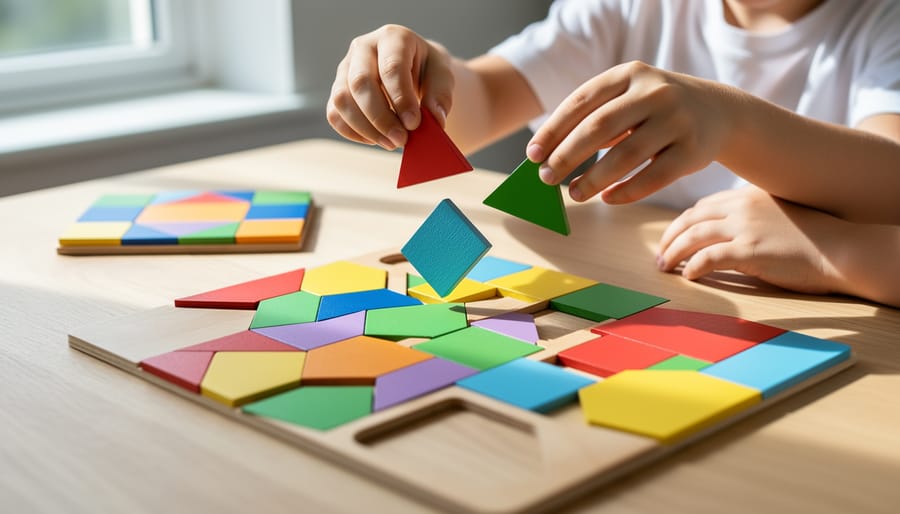
Visual and spatial logic puzzles give fourth graders a hands-on way to build reasoning skills through shapes, patterns, and physical problem-solving. These puzzles ask kids to fit geometric pieces into grids, navigate mazes using logical rules about direction and sequence, or solve tangram-style challenges where they must rotate and arrange shapes to match a target silhouette. Unlike text-heavy grid puzzles, these types of educational games let students think in three dimensions, making them perfect for learners who thrive with tactile or visual tasks.
Spatial puzzles strengthen geometry concepts, symmetry, rotation, and congruence, while still requiring step-by-step logical thinking to reach a solution. A child might need to figure out which tetromino fits a gap, or determine the correct path through a logic maze where each turn depends on meeting certain conditions. Because these puzzles feel more like play than traditional worksheets, they offer a refreshing break during longer learning sessions while keeping critical thinking front and center. They work beautifully as early finisher activities or rainy-day challenges, giving kids a chance to stretch different cognitive muscles while staying fully engaged.
Where to Use These Puzzles (and When)
Logic puzzles fit beautifully into many parts of your 4th grader’s day, whether you’re teaching at home or managing a busy classroom. The key is matching the puzzle to the moment, and your child’s energy level.
Here are the ideal spots to try:
- Homeschool curriculum supplement during math or critical thinking blocks
- Classroom math centers for hands-on reasoning practice
- Early finisher activities that challenge rather than just fill time
- Rainy-day brain breaks when outdoor play isn’t an option
- Quiet independent work for focused problem-solving
- Gifted learner challenges that push beyond grade-level content
Start with 3×3 grids during structured learning time, when kids can ask questions and think aloud. Save 4×4 puzzles for students who’ve mastered the basics and need extra challenge. Keep a few printable PDFs handy for transitions or unexpected downtime, they’re portable, screen-free, and instantly engaging. If you’re working with mixed abilities, offer two difficulty levels side by side so every child finds the right entry point. Celebrate small wins, and let kids trade puzzle types when frustration hits. Sometimes switching from a math logic puzzle to a visual spatial challenge refreshes their thinking and keeps the momentum going.
Choosing the Right Format: Printable vs. Paperless
When you’re choosing logic puzzles for your fourth grader, format matters just as much as difficulty level. Both printable PDFs and paperless digital versions have unique strengths, so the best choice depends on where and how you plan to use them.
Printable PDFs shine when you want screen-free learning time. Kids can work with pencil and paper at the kitchen table, in the car during long trips, or anywhere without WiFi. They’re perfect for homeschool portfolios, classroom centers where multiple students need simultaneous access, and rainy afternoons when you just want to hand over a fresh puzzle and a pencil. Many parents appreciate having physical copies they can file away or tuck into a travel bag.
Paperless versions using Google Slides offer different advantages. Students can reset and retry puzzles without printing multiple copies, making them ideal for practice until mastery. The digital format often includes interactive features like drag-and-drop clues or color-coding tools that help visual learners track their reasoning. For teachers, paperless puzzles mean zero prep time and easy assignment through learning management systems.
Consider your setting: if screens are already part of your daily routine and you value reusability, go digital. If you’re limiting screen time or need portable, no-tech options, printables work beautifully. Many enrichment sets offer both formats, so you can switch based on the day’s needs.
Frequently Asked Questions
What skill level should my 4th grader have before trying logic grid puzzles?
Most 4th graders can start with simple 3×3 grid puzzles right away, even if they’ve never solved one before. For more challenging 4×4 grids, students should have experience with medium-level puzzles first so they can handle the extra complexity without getting overwhelmed.
How many puzzles should I start with?
Begin with three to five puzzles and see how your child responds. If they breeze through them, you’ll know they’re ready for more challenging formats or a larger set.
Are logic puzzles aligned with school standards?
Many logic puzzle resources, including the Math Logic Puzzles: 4th grade ENRICHMENT sets with 14 higher-order thinking challenges, are specifically designed to align with Common Core State Standards for Math. They reinforce reasoning, problem-solving, and critical thinking skills that connect directly to what students learn in school.
What if my child gets frustrated?
Frustration is normal when learning something new. Take a break, work through one puzzle together to model the thinking process, or switch to an easier format temporarily to rebuild confidence before returning to the trickier ones.
Logic puzzles work beautifully for group activities too. Partner or small-group solving encourages collaboration and lets students talk through their reasoning out loud, which deepens understanding for everyone involved.
Logic puzzles aren’t just fun brain-teasers, they’re powerful tools that build the critical thinking and problem-solving skills your 4th grader will use for years to come. Whether you start with simple 3×3 grids or dive into story-based challenges, each puzzle strengthens reasoning abilities, teaches persistence, and shows kids the satisfaction of cracking a tough problem through careful thinking.
The beauty of these seven puzzle types is that you can mix and match based on your child’s interests and skill level. Try printables for screen-free afternoons, digital versions for interactive practice, or escape room games for group excitement. Celebrate every solved puzzle, those “aha!” moments when the grid finally clicks are pure magic.
Make logic puzzles a regular part of your learning routine, whether it’s ten minutes during breakfast, a classroom center option, or a rainy-day challenge. The confidence and logical thinking your 4th grader builds now will serve them in math class, science experiments, and everyday decisions. Start with one puzzle type that sounds fun, and enjoy watching your young problem-solver tackle increasingly tricky challenges with growing skill and enthusiasm.

